Showing posts with label silos. Show all posts

Saturday, June 13, 2015

Life's Messy - Clean it Up

That was the slogan of some paper towel brand many years ago.  If only some messes were that easily taken care of.

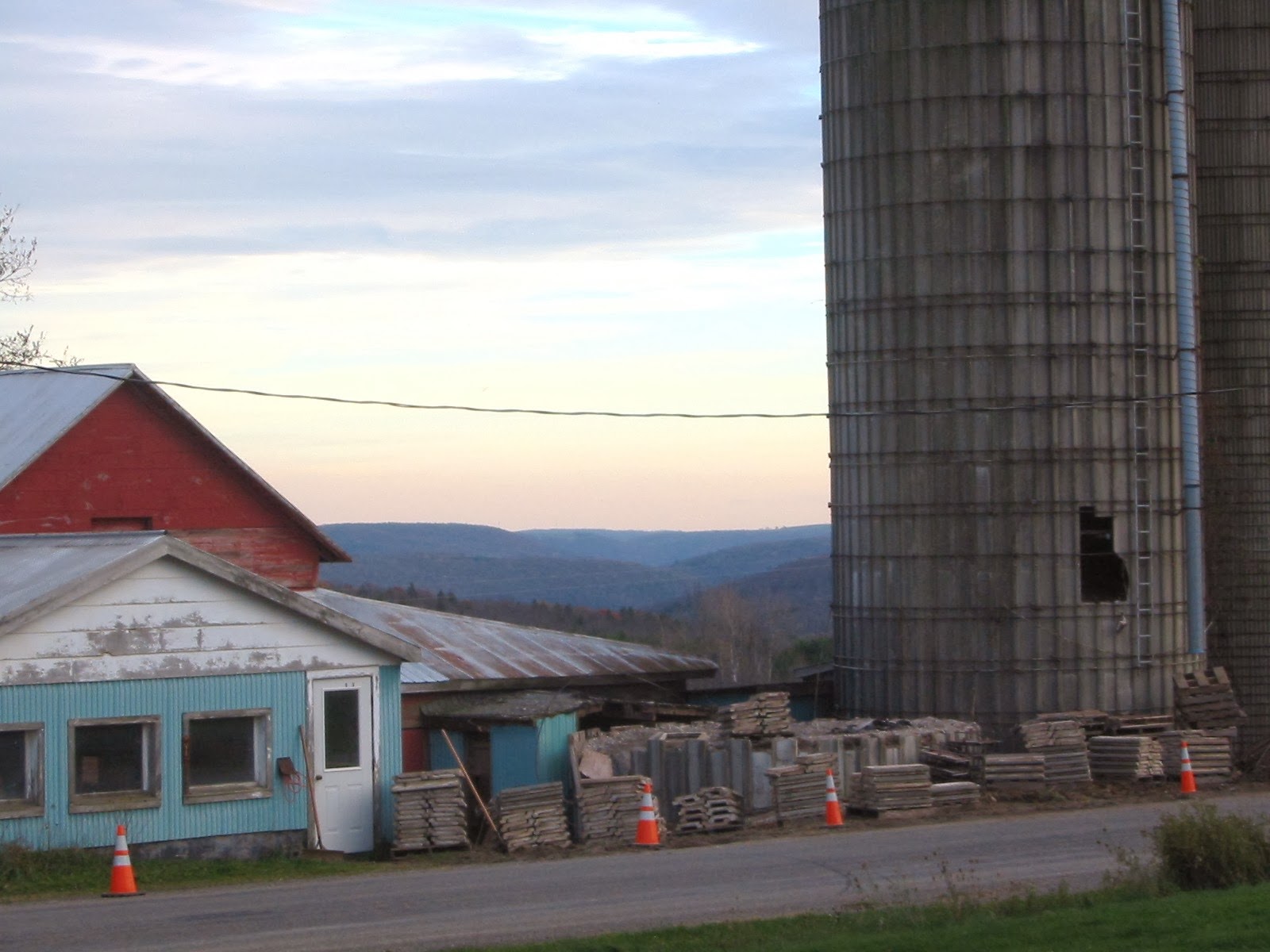
The pillars of silage left behind when the Mennonite folks took down two of our silos were still here this spring - sadly, no magic snow fairies whisked them away during the winter.  Andy was able to remove some of it with the tractor bucket last year but the concrete staves still embedded in the ground were reinforced with metal rods which would puncture a tractor tire faster than you could say "Oh, $*%&$!" if you ventured over them.  We needed something with a longer reach.

Thankfully, the neighbor who installs fence also does backhoe work and was available (due to heavy rain making a swamp of the fence job he was working) to come and dig the old silage out and load it on the dump wagon so Andy could then discard it at the edge of the woods. It will rot down quickly - the loads he took there last summer were already hardly noticeable.  What a pleasure to see the big job be done so quickly and with such a masterful hand!


There was two days worth of digging here.  It was amazing that the silage in the very bottom was still pleasant to smell.  I don't know if animals would have wanted it but it was a nice surprise to us that it wasn't foul to work around.   You can see how far down he was reaching - that void will have to be filled and the ground graded and seeded. 

When he was done he loaded himself back on the trailer.  It made me think of a hen settling herself down on a nest - careful approach, shimmy a little to get just right, settle down.... ahhhh.  (I have no idea what those buzzing sounds partway through are - maybe that mothership trying to contact me again.)


Better...... I guess.  It looks pretty naked and shabby with circa 1964 sheet metal and unpainted wood exposed for the world to see.  


Eeesh, it doesn't exactly enhance the look of the place but at least now Andy can reach the building to start to dismantle it.  First though he has to fill those craters left by the removal of the spoiled silage.  We have a very large mound of mixed stone left from the reclamation of the gas well drilling area and that will be put to good use here.  (Well, some of it - it's a very large pile).  But the silage is gone and that's a good thing.

One more chunk of a very big job done!

Thursday, August 7, 2014

Color Us Busy

The weather has been keeping us from making hay but we'll be grateful that we've only had two rains in the last week that together added three inches to our waterlogged ground.  Within fifteen miles of us there have been rains of eight inches and seven inches falling in a span of less than eight hours.  You know it's bad when your phone sends a Severe Flash Flood alert.  Good grief, isn't 'flash flood' severe enough in its own right?

One ten acre field of alfalfa that we were planning to bale is a loss.  Due to not being able to cut it when it should have been cut, an infestation of burdock grew to enormous size in the three cool wet weeks in late July.  Literally over my head they covered about forty percent of the field and worst of all they had set burrs.  Even if we could somehow run them through the haybine and baler it would be terrible to try to feed it to sheep.  Besides getting in their fleece the burrs would cling to face wool and get in their eyes..... nothing for it but to do damage control and brush hog the whole field down to the ground.  Andy was gnashing his teeth doing that - brush hogging alfalfa!  But maybe it will grow back sufficiently that we could get a second cutting..... maybe.  We've got less than half the hay we'll need for the flock.  We even called the man who leases ground from us and asked if he still had the hay he had baled here in June.  He does, and thank goodness if worse comes to worst we can buy some back from him.  They are big square bales weighing about 750 lbs each and would be a logistical challenge to feed indoors but at least it's a workable Plan B if we need it.

In the meantime we've found plenty of jobs to do.  Andy's been working on taking loads of the silo leftovers away and dumping the debris on the edge of the woods.  The crap on top of the piles (literally - pigeon crap) sprouted all sorts of things once it was exposed to sun and rain.  The tops of the piles were starting to look like the Hanging Gardens of Babylon but not in a good way.  One thing we found growing was pokeweed, a toxic nasty that we have never seen growing around here.  Where the stupid birds brought it in from in anyone's guess. 

I've been working in the wool shed as much as possible.  People are still - still! - patiently waiting for their reserved fleeces and I've whittled the list down a good bit.  I've also been working toward having goods ready to go on the shelves at Finger Lakes Fiber Festival. A lot of fiber, yarn and wool products are parked in the Fiber and Art Emporium in Hammondsport and rather than take them out for the festival I'd prefer to just have more new and different things at the festival.

I've been washing and dyeing wool.........

 
The black on the far end is a natural color but the red and purple are dyed over gray fleece.  It gives a lot of shading variation.


This is mostly Cotswold so there's a lot of shine, too.
 
 
And curl........


I wanted a lighter orchid shade too so I did another pot and combined some fuchia (a kind word for neon pink) and sky blue.  Even though the powder had dissolved and blended in the dyebath it "broke" when I added the fiber and some blue went here and some pink went there.  It *should* blend together into a lilac when carded but the jury's out on this one till it actually comes back.  I can feel some natural-color-loving friends getting queasy right about now. ;-)
 
 
Oh......my.  Yeah.


I did wash a big lot of white Cotswold too. And I skeined and dyed a good bit of fingering weight singles yarn.  I have yet to reskein it - that breaks up the blocks of color and gives a more finished look to the skein.  I can do that closer to the festival.  Getting fiber to the mill so it would have time to return before FLFF was more important.
 
 
I love how shiny the Cotswold is and how the colors melt together.


We've also taken a lot of pictures of sheep and lambs for people who are looking for breeding stock.  A group of four yearling Cotswold ewes went to their new home yesterday.  This photogenic lamb and a yearling are headed to a new home in Maryland later this month.
 
"Where's Merry-Lamb?  Sounds like a nice place to live!"
 
Fingers crossed that we can get back to making hay this weekend.  They are calling for four dry days.  Let's see if they're right.


Friday, May 30, 2014

When the Sun Comes Out

We had a nice, mostly sunny day today so we wanted to do outside work as much as possible.  I've been dyeing some Cotswold and this is the first day I could lay it out on the concrete side porch to dry. 

 
Yes, the color du jour is GREEN.  Actually there are several shades of green in there but it doesn't show up well from farther away.  There's a good amount of your basic medium green.....


....some that's more of a blue spruce type of green......


....  and some locks are either kind of acid green.....


......or a dark green like seaweed.  I think the yarn you could spin from this when it's roving will be lovely with subtle color shifts that will give it depth.  We'll see.


One reason the wool can be laid out to dry here is that we sacrificed the hedge.  Yes, while it was nice for many many years the time had come - parts of it had died out leaving big gaps.  I also had a hard time keeping it in check.  That was a lot of time with pruning shears!  Also, in the semi-near future we're going to have to address the fact that the concrete porch slab is tilting toward the house and running all rainwater right onto the foudation.  The concrete has to come up.  NOT a job we're looking forward to and not going to happen right away (unless there's a crisis - please, no!) and the hedge would have to come out at that point anyway.  Andy took it down right at ground level with the chain saw so we can mow over that area.  I'll sure miss the perfume of the blossoms.  Sigh.

 
The fields are still too wet to plow (we're skipping corn but would like to put in oats) so Andy got started on cleaning up the mess left from having the two middle silos taken down.  He used the back blade on the tractor to smooth out the ruts and now can work with the tractor to ferry away the short towers of compacted silage left behind.


This will take a lot of loads with the dump trailer as there is probably 50 tons between the two.


Thank Heavens for hydraulics or we'd be out there with pitchforks slinging it onto the wagon one teensy smidgen at a time.


Check out the giant allium!  They are just coming into full bloom.


I love a plant that thrives with neglect.


Lots of little stars making perfect spheres. 


Dexter says,

"I can't believe they won't let me be an outside cat.  It's so depressing.....enough to make you bang your head against the wall... until you fall asleep."

Sunday, December 1, 2013

Sunday Stills Challenge: Night Shots

Any type of night shot.....


It's a bit grainy, but this was late last winter around 11 PM.  The moon was full, there had been freezing fog earlier and there was a fresh light snow on everything too.  The silo roofs looked like they were glowing so I thought I'd see what my point and shoot could do on a slow manual setting.  I like this especially since the two silos on the left are gone now. 

Tuesday, November 19, 2013

Gone But Not Forgotten

Monday and today a great big flatbed tractor trailer has ferried away the parts of the two silos that are going to live a new life on another farm.


The driver brought his skid steer as he will wear two hats and also be the person loading the trailer.  Happily the skidder is on rubber and not metal cleats.  He had to cross the road with each pallet and our road supervisor would have been Not Happy to have the road all chewed up.  Andy and I went out each time after he had left and scraped the mud and gravel out of the road with the barn scrapers so no one would suffer stone pecks on their car.


The first load comprised twenty-two pallets of staves - a bit over forty thousand tons.


The second load included about half the steel silo hoop sections bundled atop the pallets.

 
The third load included the last of the staves, the rest of the hoop parts and the skid steer.  I asked the driver if he would be done after delivering this load.  No, he had to go to Potter and pick up a load of apple boxes, do some maintenance on the truck and then head for New York City.  Eeesh.  Another hard working guy.
 
 
Speaking of hard working guys, That Andy has been picking corn.  The first few days of running was great, then we got three-tenths of an inch of rain and temps hovering around freezing so now it's a cold slog through mud.  He has about one more load from the first field then he moves to the next.


"I like that fella and all, but I just don't know why you're letting him take our stuff."

 
After corn picking he'll go back to cutting firewood.  Then the barns will need to be cleaned following the end of breeding season.  Then.....he can think about "tidying up" where the silos stood.  Sigh.


Saturday, November 9, 2013

Done! Sorta....Well... Not Really

Late yesterday as the Hoovers were finishing work on the second silo it started to spit snow.


They had removed the scaffolding when it was no longer helpful and could finish while just walking on the surface of the silage.  For some reason there had been a lot of staves at the top of this silo that were more fragile than the others had been and they broke in the process of removal.  If they broke cleanly into two or three big pieces they were gathered up and stacked together for later repair.  When the silos are erected in the new location the new owners will have the inside ShotCrete-ed for strength and that will hold the pieces together like super glue.  Still, there were a lot that weren't salvagable.  As it worked out, the best place to put the rubble was on top of the silage pile.  It's not underfoot and when Andy gets time to start cleaning this area up he can just lift the front end loader on the tractor and toss the bits in.

I had assumed that they would stop taking staves when they reached the silage or maybe one layer down.  Not so!  They continued pulling them off right down to the ground. 


The column of silage has the consistency of plywood on the outside and shows no sign of collapse.  I'm sure it would slump over time but if plans work out as hoped there won't be an opportunity for time and wet weather to work on it.


We're pretty sure it's timothy haylage.  One unexpected delight is that it still smells like nice silage!  Hard to believe after all these years but there has been little deterioration where the forage was pressed tight against the silo wall.  I expect the scent will wear away soon but what a pleasure to smell sweet and tangy silage again. 


There has been some rot at the base of the silo on the side that faces the barn.  Here the silage just crumbles without support.The staves had been eaten away to the point that you could stick you flat hand under and between a couple.  This was a chief reason we really, really needed to address removing them sooner rather than later.  How much better to take them down than pick them up.  :-O


A daunting accumulation of staves on pallets waits for transport.  They said a tractor trailer would likely be here at the end of next week to pick the all up.


We're going to leave the caution cones up till they are removed.  We've never yet had anyone veer off the road here (that we saw!) but I'm pretty sure a car would come off the loser in an encounter with these. 

So for now it's back to our regular work - cutting firewood and working with wool - but with thoughts running through the back of our minds about when clean up could reasonably start and how best to address filling in the craters and fixing up the barn. 

I think we're not done yet.

Friday, November 8, 2013

The Second Silo

The Hoovers rolled in promptly at nine o' clock yesterdat morning.  No small feat since they undoubtedly fed and milked the cows, fed the young stock, cleaned the barn, eat breakfast, loaded up tools and additional people and then drove over.  It dawned on us as we talked with some of the men that they switch out helping for one full day.  Seems like a good system.  Everyone helps the person whose project it is by contributing labor for one day but nobody has to neglect the work at home for more than a day.

First task - removing the hoops and roof of the silo.

 
Then the filler pipe and exterior ladder.


View from the back side of the silo as the first course was taken off.    Note that the silo next to it has a metal and fiberglass ladder chute.  Different choice of materials by a different maker but it serves the same function.  Besides being a safety measure, the chute gives you something to brace your back against as you're standing on the ladder and using both hands to manipulate a wooden silo door.

 
The man on the right is reaching down and removing the bolts on the hoop below him so it will drop to the ground and allow them to remove the next course of staves.


Dropping staves......


They didn't quite get done with it today. And there will be a very large load of staves on pallets to take away. I'm very glad I'm not the one who will have to drive the truck down the hills of Prattsburgh!


Wednesday, November 6, 2013

Going.......Going.......

The Hoovers pulled in bright and early this morning to continue work on the silos.  We put the largest group of sheep, the non-breeders, out to pasture to prevent the frightened meltdown that surely would have occured if we had tried to keep them in the barn and yard today.  Fortunately, the weather was lovely for them.


The first order of business was to remove the secondary hoops on the lower half of the silo. Many steel hoops completely encircle the silo with extras on the bottom.  The lower section bears the brunt of stress when the silo is full.  Think of all the downward pressure from the weight above.... the pressure to burst outward is enormous so the steel hoops are essential and they double them up on the lower half of the structure.  An empty silo isn't under that pressure so some of them can come off.  It also speeds the process if you take some off before getting started.

 
When the hoops are applied during construction they are tightened in place from both ends at the same time with the help of these clever little connectors.  Tighten the two nuts and the hoops contract.


Sections of hoop gathered for transport.


The men quickly began work at the top of the silo - tap the staves with a sledge hammer to break the light mortar seal, wiggle them free and drop them one at a time to the pile of loose dirt below, yelling "Stave!" as each one falls.  This view from the back of the silo shows the concrete chute enclosing the ladder used to access the wooden doors in the silo wall.  You can just see an empty door frame at the top of the chute.  Actually, in an economy of material, the ladder in the chute consists of rungs built into the wooden doors.  Each door has two rungs and when they are fastened into the door frames they create the ladder.

 
Here about five courses have been removed and neatly stacked on pallets for transport.  Each stave weighs 72 lbs, so for a silo this size the staves alone weigh 40 tons.  Then there is the weight of the unloader and all the steel hoops, the roof, wooden doors......it will take several trips with the big flatbed trailer to move it all to the new "home".
 
 
They brought their own skidder with them for moving pallets around.


Tires modified with steel cleats to keep in contact with the ground.......

 
We kept checking on their progress through the day.  Here they are about half done with the first silo.  You can see a stave in freefall almost in the middle of the silo.  There is a crane arm on the scaffolding (pointing to the left from the top of the silo) and it's used to pull staves up when a silo is being built but for deconstruction they choose to drop the pieces into soft dirt.  It's faster.  They did use the crane to lower wooden doors and the more fragile concrete door frames.  Those are built like a picture frame and wouldn't survive the landing if dropped.


They worked steadily through the day.  I had some errands in town and then worked on fleece in the wool shop.  Andy spent some time dealing with the corn picker.  It will be pressed into service soon and needed bearings and some other parts replaced.  Of course you can't just reach in and get that one part, you have to take a whole lot of other parts off first.  And remember the order they came off in.


Almost down to the level of the old spoiled silage (plus several inches of pigeon dung.  Ick.)


Finished with that silo except for some picking up of small parts.  Now they're using the skidder to lift the scaffolding parts into the next silo.  They did get that erected inside before they were done.  You can count on their quitting time - they have to go home and milk the cows.


Done for the day.  Stacks of staves on pallets waiting for transport.


Wooden doors stacked to be loaded.  See the two metal rungs?


The road supervisor lent us some orange caution cones to use along the road.  The Hoovers were very neat and careful.  We barely scraped a wheelbarrow's worth of gravel off the road's edge.  Call me goofy (and it wouldn't be the first time.  Heh.) but there's something very pleasing about watching a team of men labor well together.  No screaming at each other, no confusion, no conflicting directions about how to proceed.  They worked quickly, smoothly, neatly and with no casual four-letter language being shouted into the wind (unless it was in Pennsylvania Dutch - I guess I couldnt' say for sure.)  Anyway, it was a pleasure to watch them and it gives us good vibes about the silos' next life.  The silos do represent the way we lived a large chunk of our lives, especially Andy, and it's hard enough to see them go from the landscape.  At least we know they are going to be used by people who live as we lived.


One silo gone except for the base and spoilage that we have to take away.  And look at the view that's opening up!  :-)


Wow.