Tuesday, November 19, 2013

Gone But Not Forgotten

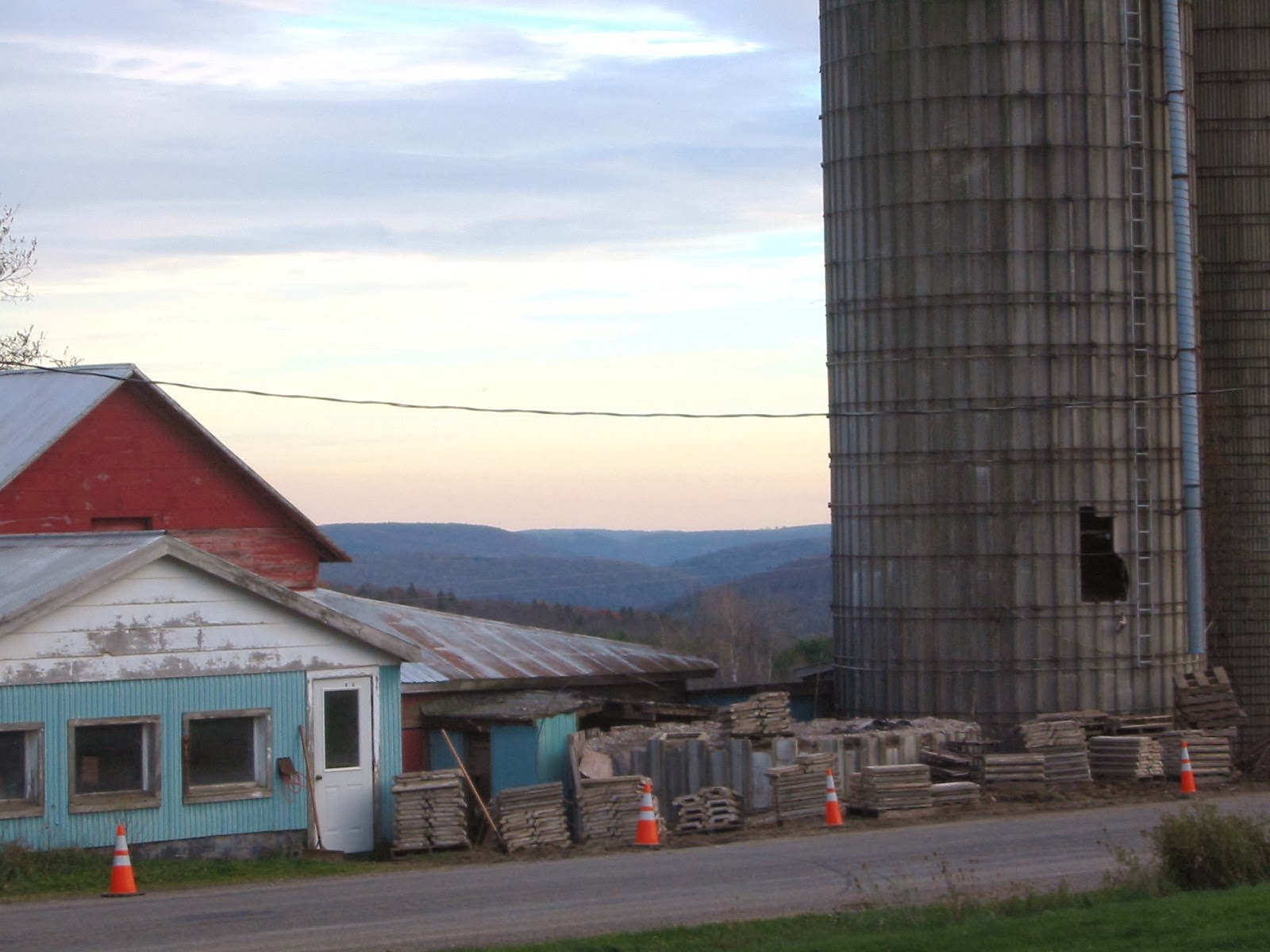
Monday and today a great big flatbed tractor trailer has ferried away the parts of the two silos that are going to live a new life on another farm.


The driver brought his skid steer as he will wear two hats and also be the person loading the trailer.  Happily the skidder is on rubber and not metal cleats.  He had to cross the road with each pallet and our road supervisor would have been Not Happy to have the road all chewed up.  Andy and I went out each time after he had left and scraped the mud and gravel out of the road with the barn scrapers so no one would suffer stone pecks on their car.


The first load comprised twenty-two pallets of staves - a bit over forty thousand tons.


The second load included about half the steel silo hoop sections bundled atop the pallets.

 
The third load included the last of the staves, the rest of the hoop parts and the skid steer.  I asked the driver if he would be done after delivering this load.  No, he had to go to Potter and pick up a load of apple boxes, do some maintenance on the truck and then head for New York City.  Eeesh.  Another hard working guy.
 
 
Speaking of hard working guys, That Andy has been picking corn.  The first few days of running was great, then we got three-tenths of an inch of rain and temps hovering around freezing so now it's a cold slog through mud.  He has about one more load from the first field then he moves to the next.


"I like that fella and all, but I just don't know why you're letting him take our stuff."

 
After corn picking he'll go back to cutting firewood.  Then the barns will need to be cleaned following the end of breeding season.  Then.....he can think about "tidying up" where the silos stood.  Sigh.


Saturday, November 16, 2013

Fiber Fun

The fiber I bought at the NEFF a couple of weeks ago to finish the Multnomah shawl has been spun up and washed.  The fiber wasn't as nice to spin as I had hoped and when washed it bled red like a wounded animal but I think it will work OK for just the last row or two of the shawl.  I swear the skein is not as red as the picture makes it seem.  I tried in natural light, artificial light, with and without a flash and have decided that either the camera sees red more strongly than it actually is, or my eyes don't see red as strongly as it really is.  :-/


Maybe I can make it look like I planned the border to be a different color.  Yeah, that's my story.  I've tinked back the section that I had bound off with the original yarn and will press on with the new color next time I pick the project up.

Lately I've been busy in the day working in the wool shop washing and dyeing Cotswold.


I've got a brown/chestnut, a black (that broke into black and deep purple) and a smaller amount of vermillion.  I'm going to have Diane at Acorn Works use her magic to give me a three way swirl roving.  I haven't delved much into dark or earth tone colors so the brown and black are an experiment for me.  Here's hoping!

Monday, November 11, 2013

Bits and Pieces

With the distraction of the silo demolition out of the way for awhile we can get back to other jobs that need doing.  Andy split firewood in the morning and had a load to dump down cellar and stack after lunch.


He backs the trailer close to the cellar stairs and raises it until the load is almost ready to slide off....


.....but then uses an old potato hook to guide the chunks down in an orderly fashion.  There is a window directly above the cellarway and a boisterous piece of wood could create a whole new job needing immediate attention.  He built wooden wedges that can be bolted to the rear corners of the trailer and they help funnel the load into a more narrow area. Only eighteen more loads to go :-/


The apple trees are still loaded with fruit.  It's hard to believe that this many are already on the ground.  I can't begin to use them all nor give them away so the rams get half a bucket every day.  I wish I knew someone nearby raising hogs.  They would do well with them.


Holly rolled in something vile behind the corncribs this morning while we were doing chores in the upper barn. She got a serious spot-washing before breakfast and went nekkid all day while her collar dried out.

"Roll in something?  I'm sure I'd remember doing something like that."
 
"I'll just pretend I don't know what you're talking about."
 
Later in the afternoon we replaced some burned out light bulbs in the feed bunk area and the sheep were a bit alarmed to see Andy sidling along the beam halfway up the wall like a big spider.
 

O M G !!
 
That was about as exciting as it got around here today and that's OK.  So goes Monday, so goes the week.  Nothing bad happening equals good!


Saturday, November 9, 2013

Done! Sorta....Well... Not Really

Late yesterday as the Hoovers were finishing work on the second silo it started to spit snow.


They had removed the scaffolding when it was no longer helpful and could finish while just walking on the surface of the silage.  For some reason there had been a lot of staves at the top of this silo that were more fragile than the others had been and they broke in the process of removal.  If they broke cleanly into two or three big pieces they were gathered up and stacked together for later repair.  When the silos are erected in the new location the new owners will have the inside ShotCrete-ed for strength and that will hold the pieces together like super glue.  Still, there were a lot that weren't salvagable.  As it worked out, the best place to put the rubble was on top of the silage pile.  It's not underfoot and when Andy gets time to start cleaning this area up he can just lift the front end loader on the tractor and toss the bits in.

I had assumed that they would stop taking staves when they reached the silage or maybe one layer down.  Not so!  They continued pulling them off right down to the ground. 


The column of silage has the consistency of plywood on the outside and shows no sign of collapse.  I'm sure it would slump over time but if plans work out as hoped there won't be an opportunity for time and wet weather to work on it.


We're pretty sure it's timothy haylage.  One unexpected delight is that it still smells like nice silage!  Hard to believe after all these years but there has been little deterioration where the forage was pressed tight against the silo wall.  I expect the scent will wear away soon but what a pleasure to smell sweet and tangy silage again. 


There has been some rot at the base of the silo on the side that faces the barn.  Here the silage just crumbles without support.The staves had been eaten away to the point that you could stick you flat hand under and between a couple.  This was a chief reason we really, really needed to address removing them sooner rather than later.  How much better to take them down than pick them up.  :-O


A daunting accumulation of staves on pallets waits for transport.  They said a tractor trailer would likely be here at the end of next week to pick the all up.


We're going to leave the caution cones up till they are removed.  We've never yet had anyone veer off the road here (that we saw!) but I'm pretty sure a car would come off the loser in an encounter with these. 

So for now it's back to our regular work - cutting firewood and working with wool - but with thoughts running through the back of our minds about when clean up could reasonably start and how best to address filling in the craters and fixing up the barn. 

I think we're not done yet.

Friday, November 8, 2013

The Second Silo

The Hoovers rolled in promptly at nine o' clock yesterdat morning.  No small feat since they undoubtedly fed and milked the cows, fed the young stock, cleaned the barn, eat breakfast, loaded up tools and additional people and then drove over.  It dawned on us as we talked with some of the men that they switch out helping for one full day.  Seems like a good system.  Everyone helps the person whose project it is by contributing labor for one day but nobody has to neglect the work at home for more than a day.

First task - removing the hoops and roof of the silo.

 
Then the filler pipe and exterior ladder.


View from the back side of the silo as the first course was taken off.    Note that the silo next to it has a metal and fiberglass ladder chute.  Different choice of materials by a different maker but it serves the same function.  Besides being a safety measure, the chute gives you something to brace your back against as you're standing on the ladder and using both hands to manipulate a wooden silo door.

 
The man on the right is reaching down and removing the bolts on the hoop below him so it will drop to the ground and allow them to remove the next course of staves.


Dropping staves......


They didn't quite get done with it today. And there will be a very large load of staves on pallets to take away. I'm very glad I'm not the one who will have to drive the truck down the hills of Prattsburgh!


Wednesday, November 6, 2013

Going.......Going.......

The Hoovers pulled in bright and early this morning to continue work on the silos.  We put the largest group of sheep, the non-breeders, out to pasture to prevent the frightened meltdown that surely would have occured if we had tried to keep them in the barn and yard today.  Fortunately, the weather was lovely for them.


The first order of business was to remove the secondary hoops on the lower half of the silo. Many steel hoops completely encircle the silo with extras on the bottom.  The lower section bears the brunt of stress when the silo is full.  Think of all the downward pressure from the weight above.... the pressure to burst outward is enormous so the steel hoops are essential and they double them up on the lower half of the structure.  An empty silo isn't under that pressure so some of them can come off.  It also speeds the process if you take some off before getting started.

 
When the hoops are applied during construction they are tightened in place from both ends at the same time with the help of these clever little connectors.  Tighten the two nuts and the hoops contract.


Sections of hoop gathered for transport.


The men quickly began work at the top of the silo - tap the staves with a sledge hammer to break the light mortar seal, wiggle them free and drop them one at a time to the pile of loose dirt below, yelling "Stave!" as each one falls.  This view from the back of the silo shows the concrete chute enclosing the ladder used to access the wooden doors in the silo wall.  You can just see an empty door frame at the top of the chute.  Actually, in an economy of material, the ladder in the chute consists of rungs built into the wooden doors.  Each door has two rungs and when they are fastened into the door frames they create the ladder.

 
Here about five courses have been removed and neatly stacked on pallets for transport.  Each stave weighs 72 lbs, so for a silo this size the staves alone weigh 40 tons.  Then there is the weight of the unloader and all the steel hoops, the roof, wooden doors......it will take several trips with the big flatbed trailer to move it all to the new "home".
 
 
They brought their own skidder with them for moving pallets around.


Tires modified with steel cleats to keep in contact with the ground.......

 
We kept checking on their progress through the day.  Here they are about half done with the first silo.  You can see a stave in freefall almost in the middle of the silo.  There is a crane arm on the scaffolding (pointing to the left from the top of the silo) and it's used to pull staves up when a silo is being built but for deconstruction they choose to drop the pieces into soft dirt.  It's faster.  They did use the crane to lower wooden doors and the more fragile concrete door frames.  Those are built like a picture frame and wouldn't survive the landing if dropped.


They worked steadily through the day.  I had some errands in town and then worked on fleece in the wool shop.  Andy spent some time dealing with the corn picker.  It will be pressed into service soon and needed bearings and some other parts replaced.  Of course you can't just reach in and get that one part, you have to take a whole lot of other parts off first.  And remember the order they came off in.


Almost down to the level of the old spoiled silage (plus several inches of pigeon dung.  Ick.)


Finished with that silo except for some picking up of small parts.  Now they're using the skidder to lift the scaffolding parts into the next silo.  They did get that erected inside before they were done.  You can count on their quitting time - they have to go home and milk the cows.


Done for the day.  Stacks of staves on pallets waiting for transport.


Wooden doors stacked to be loaded.  See the two metal rungs?


The road supervisor lent us some orange caution cones to use along the road.  The Hoovers were very neat and careful.  We barely scraped a wheelbarrow's worth of gravel off the road's edge.  Call me goofy (and it wouldn't be the first time.  Heh.) but there's something very pleasing about watching a team of men labor well together.  No screaming at each other, no confusion, no conflicting directions about how to proceed.  They worked quickly, smoothly, neatly and with no casual four-letter language being shouted into the wind (unless it was in Pennsylvania Dutch - I guess I couldnt' say for sure.)  Anyway, it was a pleasure to watch them and it gives us good vibes about the silos' next life.  The silos do represent the way we lived a large chunk of our lives, especially Andy, and it's hard enough to see them go from the landscape.  At least we know they are going to be used by people who live as we lived.


One silo gone except for the base and spoilage that we have to take away.  And look at the view that's opening up!  :-)


Wow.

Tuesday, November 5, 2013

The View From Inside

The Mennonite fellows - the Hoovers - had other work today so it gave me a chance to get some pictures of the inside of the silo.

The concrete staves fit together a bit like tongue and groove lumber.  Each one has an edge that is just narrow and plain....

 
...and a side that is thicker and has a groove that receives the narrow edge of the adjacent one.
 
 
The lower fifteen feet or so of the inside of the silo is really showing deterioration.  Silage is acidic and that environment eats concrete over time.  The inner surface is spalling off and making the staves thinner. 
 

"Oh my gosh, that shape - if  I squint I think I see....Elvis?!"


The squares areas are wooden doors that can be removed wherever the forage level is when you need to access the silo as it's being filled or emptied.   The bottom two (above) have been taken out and you can see the staves that form a tube surrounding the access ladder.  They are undamaged by time and acid since forage never touches them.


The view looking straight up at the scaffolding the Hoovers will walk on to disassemble the silo.  It's essentially a very strong pipe that the spoke assembly ratchets itself up from the bottom.  Each time it's raised a pin is put through the shaft so it can't drop, then it gets ratcheted up again.  It's a bit hard to describe but basically it climbs the pole and the workers get on and off it wherever it is through the little square doors in the wall.
 
 
These skinny little arms look wholly inadequate for anything but their only purpose is to keep the center pole from wobbling or starting to bow.  They don't carry any weight.  You can see the small square wooden doors better here.  Also notice that the staves aren't so badly eaten up higher in the silo.  They have not spent as much time in contact with silage as the lower staves.  
 
The Hoovers indicated they would need a bigge pile of dirt to drop the staves onto so Andy went to a field that had a ridge of earth built up from plowing and scraped some up. 


Gotta love hydraulics! 
 

************************************
To answer Bow Street Flowers' question - in our experience around here most Mennonite groups allow powered vehicles but they have to ride on steel, not rubber.  As best I understand it, it has to do with staying in contact with the earth.  The Amish orders tend to be more strict than Mennonites and allow gas powered engines - for example, hay balers - but they are stationary during work and the Amish use draft horses instead of tractors or other powered vehicles.  Mennonite folks have all the "modern" agricultural equipment - tractors, combines, riding lawn mowers - but they all have steel wheels.  This is a real problem on paved roads and some are adapting to rubber tires BUT with steel knobs or cleats embedded in the rubber so they are still compliant with the Mennonite tenet of always touching earth.  To travel on public roads for activities such as this they hire drivers.