Showing posts with label concrete. Show all posts

Saturday, November 9, 2013

Done! Sorta....Well... Not Really

Late yesterday as the Hoovers were finishing work on the second silo it started to spit snow.


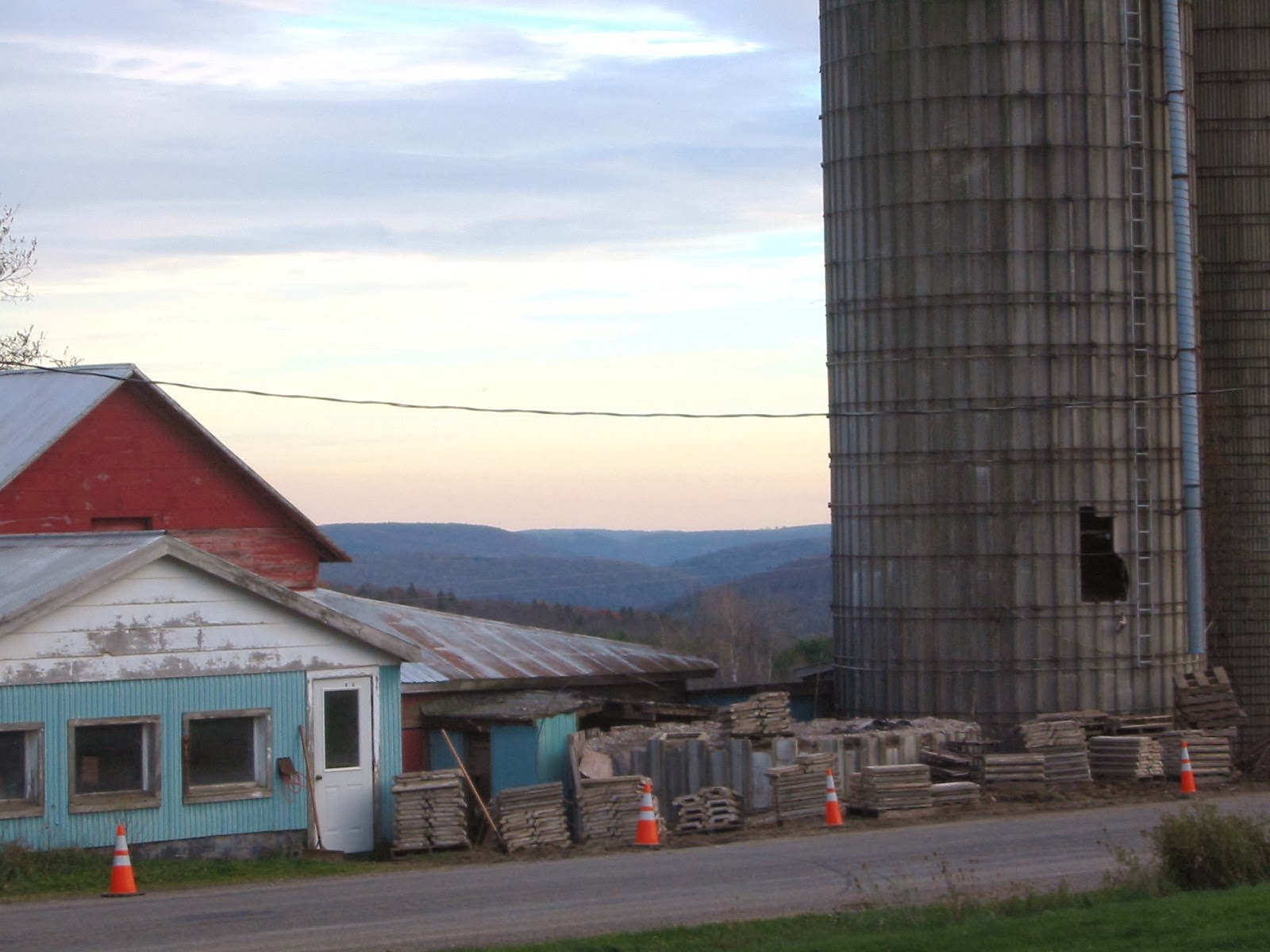
They had removed the scaffolding when it was no longer helpful and could finish while just walking on the surface of the silage.  For some reason there had been a lot of staves at the top of this silo that were more fragile than the others had been and they broke in the process of removal.  If they broke cleanly into two or three big pieces they were gathered up and stacked together for later repair.  When the silos are erected in the new location the new owners will have the inside ShotCrete-ed for strength and that will hold the pieces together like super glue.  Still, there were a lot that weren't salvagable.  As it worked out, the best place to put the rubble was on top of the silage pile.  It's not underfoot and when Andy gets time to start cleaning this area up he can just lift the front end loader on the tractor and toss the bits in.

I had assumed that they would stop taking staves when they reached the silage or maybe one layer down.  Not so!  They continued pulling them off right down to the ground. 


The column of silage has the consistency of plywood on the outside and shows no sign of collapse.  I'm sure it would slump over time but if plans work out as hoped there won't be an opportunity for time and wet weather to work on it.


We're pretty sure it's timothy haylage.  One unexpected delight is that it still smells like nice silage!  Hard to believe after all these years but there has been little deterioration where the forage was pressed tight against the silo wall.  I expect the scent will wear away soon but what a pleasure to smell sweet and tangy silage again. 


There has been some rot at the base of the silo on the side that faces the barn.  Here the silage just crumbles without support.The staves had been eaten away to the point that you could stick you flat hand under and between a couple.  This was a chief reason we really, really needed to address removing them sooner rather than later.  How much better to take them down than pick them up.  :-O


A daunting accumulation of staves on pallets waits for transport.  They said a tractor trailer would likely be here at the end of next week to pick the all up.


We're going to leave the caution cones up till they are removed.  We've never yet had anyone veer off the road here (that we saw!) but I'm pretty sure a car would come off the loser in an encounter with these. 

So for now it's back to our regular work - cutting firewood and working with wool - but with thoughts running through the back of our minds about when clean up could reasonably start and how best to address filling in the craters and fixing up the barn. 

I think we're not done yet.

Friday, November 8, 2013

The Second Silo

The Hoovers rolled in promptly at nine o' clock yesterdat morning.  No small feat since they undoubtedly fed and milked the cows, fed the young stock, cleaned the barn, eat breakfast, loaded up tools and additional people and then drove over.  It dawned on us as we talked with some of the men that they switch out helping for one full day.  Seems like a good system.  Everyone helps the person whose project it is by contributing labor for one day but nobody has to neglect the work at home for more than a day.

First task - removing the hoops and roof of the silo.

 
Then the filler pipe and exterior ladder.


View from the back side of the silo as the first course was taken off.    Note that the silo next to it has a metal and fiberglass ladder chute.  Different choice of materials by a different maker but it serves the same function.  Besides being a safety measure, the chute gives you something to brace your back against as you're standing on the ladder and using both hands to manipulate a wooden silo door.

 
The man on the right is reaching down and removing the bolts on the hoop below him so it will drop to the ground and allow them to remove the next course of staves.


Dropping staves......


They didn't quite get done with it today. And there will be a very large load of staves on pallets to take away. I'm very glad I'm not the one who will have to drive the truck down the hills of Prattsburgh!


Wednesday, November 6, 2013

Going.......Going.......

The Hoovers pulled in bright and early this morning to continue work on the silos.  We put the largest group of sheep, the non-breeders, out to pasture to prevent the frightened meltdown that surely would have occured if we had tried to keep them in the barn and yard today.  Fortunately, the weather was lovely for them.


The first order of business was to remove the secondary hoops on the lower half of the silo. Many steel hoops completely encircle the silo with extras on the bottom.  The lower section bears the brunt of stress when the silo is full.  Think of all the downward pressure from the weight above.... the pressure to burst outward is enormous so the steel hoops are essential and they double them up on the lower half of the structure.  An empty silo isn't under that pressure so some of them can come off.  It also speeds the process if you take some off before getting started.

 
When the hoops are applied during construction they are tightened in place from both ends at the same time with the help of these clever little connectors.  Tighten the two nuts and the hoops contract.


Sections of hoop gathered for transport.


The men quickly began work at the top of the silo - tap the staves with a sledge hammer to break the light mortar seal, wiggle them free and drop them one at a time to the pile of loose dirt below, yelling "Stave!" as each one falls.  This view from the back of the silo shows the concrete chute enclosing the ladder used to access the wooden doors in the silo wall.  You can just see an empty door frame at the top of the chute.  Actually, in an economy of material, the ladder in the chute consists of rungs built into the wooden doors.  Each door has two rungs and when they are fastened into the door frames they create the ladder.

 
Here about five courses have been removed and neatly stacked on pallets for transport.  Each stave weighs 72 lbs, so for a silo this size the staves alone weigh 40 tons.  Then there is the weight of the unloader and all the steel hoops, the roof, wooden doors......it will take several trips with the big flatbed trailer to move it all to the new "home".
 
 
They brought their own skidder with them for moving pallets around.


Tires modified with steel cleats to keep in contact with the ground.......

 
We kept checking on their progress through the day.  Here they are about half done with the first silo.  You can see a stave in freefall almost in the middle of the silo.  There is a crane arm on the scaffolding (pointing to the left from the top of the silo) and it's used to pull staves up when a silo is being built but for deconstruction they choose to drop the pieces into soft dirt.  It's faster.  They did use the crane to lower wooden doors and the more fragile concrete door frames.  Those are built like a picture frame and wouldn't survive the landing if dropped.


They worked steadily through the day.  I had some errands in town and then worked on fleece in the wool shop.  Andy spent some time dealing with the corn picker.  It will be pressed into service soon and needed bearings and some other parts replaced.  Of course you can't just reach in and get that one part, you have to take a whole lot of other parts off first.  And remember the order they came off in.


Almost down to the level of the old spoiled silage (plus several inches of pigeon dung.  Ick.)


Finished with that silo except for some picking up of small parts.  Now they're using the skidder to lift the scaffolding parts into the next silo.  They did get that erected inside before they were done.  You can count on their quitting time - they have to go home and milk the cows.


Done for the day.  Stacks of staves on pallets waiting for transport.


Wooden doors stacked to be loaded.  See the two metal rungs?


The road supervisor lent us some orange caution cones to use along the road.  The Hoovers were very neat and careful.  We barely scraped a wheelbarrow's worth of gravel off the road's edge.  Call me goofy (and it wouldn't be the first time.  Heh.) but there's something very pleasing about watching a team of men labor well together.  No screaming at each other, no confusion, no conflicting directions about how to proceed.  They worked quickly, smoothly, neatly and with no casual four-letter language being shouted into the wind (unless it was in Pennsylvania Dutch - I guess I couldnt' say for sure.)  Anyway, it was a pleasure to watch them and it gives us good vibes about the silos' next life.  The silos do represent the way we lived a large chunk of our lives, especially Andy, and it's hard enough to see them go from the landscape.  At least we know they are going to be used by people who live as we lived.


One silo gone except for the base and spoilage that we have to take away.  And look at the view that's opening up!  :-)


Wow.

Tuesday, November 5, 2013

The View From Inside

The Mennonite fellows - the Hoovers - had other work today so it gave me a chance to get some pictures of the inside of the silo.

The concrete staves fit together a bit like tongue and groove lumber.  Each one has an edge that is just narrow and plain....

 
...and a side that is thicker and has a groove that receives the narrow edge of the adjacent one.
 
 
The lower fifteen feet or so of the inside of the silo is really showing deterioration.  Silage is acidic and that environment eats concrete over time.  The inner surface is spalling off and making the staves thinner. 
 

"Oh my gosh, that shape - if  I squint I think I see....Elvis?!"


The squares areas are wooden doors that can be removed wherever the forage level is when you need to access the silo as it's being filled or emptied.   The bottom two (above) have been taken out and you can see the staves that form a tube surrounding the access ladder.  They are undamaged by time and acid since forage never touches them.


The view looking straight up at the scaffolding the Hoovers will walk on to disassemble the silo.  It's essentially a very strong pipe that the spoke assembly ratchets itself up from the bottom.  Each time it's raised a pin is put through the shaft so it can't drop, then it gets ratcheted up again.  It's a bit hard to describe but basically it climbs the pole and the workers get on and off it wherever it is through the little square doors in the wall.
 
 
These skinny little arms look wholly inadequate for anything but their only purpose is to keep the center pole from wobbling or starting to bow.  They don't carry any weight.  You can see the small square wooden doors better here.  Also notice that the staves aren't so badly eaten up higher in the silo.  They have not spent as much time in contact with silage as the lower staves.  
 
The Hoovers indicated they would need a bigge pile of dirt to drop the staves onto so Andy went to a field that had a ridge of earth built up from plowing and scraped some up. 


Gotta love hydraulics! 
 

************************************
To answer Bow Street Flowers' question - in our experience around here most Mennonite groups allow powered vehicles but they have to ride on steel, not rubber.  As best I understand it, it has to do with staying in contact with the earth.  The Amish orders tend to be more strict than Mennonites and allow gas powered engines - for example, hay balers - but they are stationary during work and the Amish use draft horses instead of tractors or other powered vehicles.  Mennonite folks have all the "modern" agricultural equipment - tractors, combines, riding lawn mowers - but they all have steel wheels.  This is a real problem on paved roads and some are adapting to rubber tires BUT with steel knobs or cleats embedded in the rubber so they are still compliant with the Mennonite tenet of always touching earth.  To travel on public roads for activities such as this they hire drivers.

Monday, November 4, 2013

The End Of An Era

That sounds dire.  I guess I should say we're just taking the next step in the evolution of the farm.  But it's true - there is a clear signal that the dairy days are irrevocably Over.  Disassembly of two of our six silos began today.

The center and left silos are 18 feet across by 50 feet high. The one to the right is 60 feet tall. 
 
When we sold the dairy cows in 2000 we were in no hurry to deal with them.  They were in good shape, we were still flirting with the idea of maybe having some beef cattle and there were just so many other things to think about.  The silos weren't hurting anything so they didn't get much thought.  Fast forward (it was fast, too!) ten years and it had become apparent that we were never going to have a use for them.  More than that, time was gnawing on them every year and we knew we would have to address them before long.  Even concrete becomes fragile with time.   Unfortunately, this is one job Andy couldn't undertake himself even if he was desperate.  It takes very particular equipment to un-build a silo.
 

Finding a company to take them down proved difficult.  First, such businesses are about as common as buggy whip factories - there just isn't much call for them anymore.  There are people who will topple them (judging by some videos I've seen some of those guys apparently have a day job as stunt people for the Jackass TV series) and leave you to clean up the mess.  This was not an option - even assuming that the silo could be steered accurately - since the silos are surrounded by the barn, other silos, the road and power lines.  Price was also a factor - one company who would take a silo apart quoted at least 4K per silo PLUS the cost of a cherry picker rental and mileage from the other side of the state AND they would leave you the rubble to clean up.  We decided to bide our time and watch for leads.

An expanding Mennonite community a few towns over finally afforded us an opportunity.  When an ad appeared in the Country Folks newspaper for used silos to be taken down and reused, we pounced!  They came to look over the situation, we discussed details and a happy deal was struck.  They would take the 2 middle ones now and would probably plan to take the others in the near future when they could find other farmers new to the area who would need them.  One of the fellows has worked on a silo crew for some years and has his own scaffolding - the crucial piece of equipment - and so they are beginning today.

Step one - take a sledgehammer and knock a few staves out near the bottom.  There is still a few feet of spoilage in the bottoms of these two.  The hole is right at the level of the surface of that material. 


The rightmost silo has several feet in it so the hole is up higher.

 
The flatbed is loaded with pallets that will hold the concrete staves.  They'll be unloaded nearby until the actual disassembly begins.  Today they are taking the unloaders out and at least one roof off.


A brief explanation of silos in case you are unfamiliar - silos are basically a device for preserving and storing animal feed, primarily forage (alfalfa, corn, clover, timothy, etc) for dairy cattle.  The magic of a silo is that it is designed to be filled from the top with fresh green plant material (wilted to a certain degree but not much) which compresses under it's own weight to the point that it drives out air.  Without air the plant material won't rot but it WILL ferment.  The fermentation process literally pickles the plant material (think saurkraut) and will hold it in a preserved state until needed as feed.  There is some loss on the top of the silo where some air remains trapped in the forage but the vast bulk below that is good.  You have ensiled the forage.  You can have corn silage, alfalfa haylage, clover haylage, etc.  A variation of the tower silos such as ours are bunk or pit silos which are literally just trenches that you fill with forage and compact with machinery to drive the air out.  There is less cost to create that type of silo but there is greater loss to spoilage.  Another newer option is to wrap round bales with plastic to create an air tight environment - a mini silo - and thus you create baleage.

So how do you get the silage out when you need it?  A device is suspended inside from the top of the silo and lowered until it rests on the surface of the silage.  A long arm extends from the center to the outer wall and slowly sweeps in a circle chewing up the surface and sending the loose silage down a chute to be distributed to the animals.  This is the unloader and each silo has one.  These are what is being taken apart today and removed in pieces through the hole in the silo's wall.

The scaffolding is put in through the hole too, and erected inside the silo all the way to the top.  Then the roof is taken apart in sections and lowered down the outside.  As you might imagine, the sheep were mightily freaked out by this.  We put the biggest group out to pasture and shut the doors so the other penned breeding groups couldn't see what was going on.  They were nervous of the banging and other noise but tolerated it pretty well so long as they couldn't see.


The filler pipe and ladder are taken off the outside.  (To fill a tower silo you literally blow the chopped forage up the pipe on the outside to the top where it passes through a distributor and rains down inside the silo in an even pattern.)


WOW, that looks weird.
 
And the first load of parts heads for its new home.
 
 
The next step will be actual disassembly, probably Wednesday, so tune in then for another episode.
 
And don't worry - we don't give quizzes.


Saturday, October 26, 2013

More Building

Breeding season for the flock has finally arrived.  While our plan is to breed fewer ewes than last year (OK, it was almost 80.  Clearly I was delusional and the only thing that saved the situation was that many ewes only had singles.  I won't play that particular version of Russian Roulette again!) we still felt the need for more floor space to reduce crowding.

Short of building an addition onto the barn - NOT going to happen and if it did it would be because I would be living in it - the only direction to go was deeper into the main part of the dairy barn which we've been using for hay storage.  The project actually got started last spring.  If we had had a repeat of 2012's drought we would have had to have the whole flock in the barn again and there just wouldn't be room.  Thankfully the weather and pastures provided the flock with abundant forage so the task was set aside as more pressing things came to the fore.

The approach of breeding season and the multiple rams we use brought the need for the extra space back to the top of the priority list.

Andy is a wonder. In the past two weeks he has cemented in the gutter and built a space 24' by 32' that can be divided into two sections.  All the lumber came from trees from our woods that he ran over the sawmill to get the material he needed.  He also had to replace the long flourescent lights in that part of the barn with new fixtures and incandescent/halogen bulbs.  We have some early-version CFLs in other areas and hate-hate-hate them....but they're paid for so we're going to use them till they die, which can't be soon enough.  The new lights are a hundred times better but it's still wonky to take photos so apologies in advance for the quality.

 
The center panel is removable.  We decided to try using the same metal gridwork for this divider as we use for the hay feeders.  It's very strong but lighter in weight than a similar panel made all of wood.  If there are any drawbacks to the design I'm sure we'll discover them.  The large posts sticking up are set in the concrete that fills the old gutter and help anchor and stabilize everything.  I told Andy he ought to use a chainsaw and carve them into sheep totem poles.  I got "a look" for my suggestion ;-)


The panel bolts into place rather than working on hinges.  If we need to have groups separated we don't want to trust the latch of a hinged gate to keep them apart.....

 
The hay feeder is the same design as we've done previously and we added an upper board to keep chaff from falling down on the sheep's heads and necks.  And.....drumroll...... Andy built swinging gates in strategic places to manage traffic flow.  Seen above, the gate is folded back flush to the front of the pen.
 
 
Swung open, it shunts the sheep to the left and toward the open gate of the pen which in turn blocks the alleyway and gives a sheep no choices about taking a more scenic route.  It's a given that they would do that.  (Pardon the pile of debris - it will get picked up before any sheepies head this way.)
 
 
Since he was in full building mode, Andy also made two other gates down in the older section of the barn which function to make an alley between the east and west sections of the barn. They are folded back flat to the feeders when not needed....


....but swing and latch to make a quick conduit between the two areas.  Gone are the days of having to go find 2 sheets of plywood or four small lamb jug panels to make a passage.  Woot!


Tomorrow we have some finishing up to do and then the ewes have to be divided.  Later in the afternoon when they've settled in a bit we'll bring the rams down and put each in with his harem. 

Once the sheep are all organized for the duration we can get back to work!