Showing posts with label summer. Show all posts

Monday, September 7, 2020

Signs of Fall

Our hot, dry summer is easing into a warm, dry Fall. 

The goldenrod is almost at peak bloom and bees of all types are taking advantage.  There seem to be two types of the plant around here.  This kind, with airy sprays of bloom like fireworks going off is more common.


But we also have a variety with more finely cut leaves and small globs of bloom where the flowers are arranged in clumps. 


The bees prefer this type at the moment.  I see a honey bee and two other small bees of some kind.


Although still terribly dry we are having some morning dew and the webs of little grass spiders show up well in the lawn.


"Come into my parlor...."


The cooler morning temperatures create a river of fog down in the valley.  Every year I'm reminded of how good it is to live up on a hilltop where you aren't stuck for hours in the fog every morning in the Fall.


Even when the fog lifts and trails away over the ridge the valley will still be stuck in a clammy mist all morning. 


We've been to the woods last week and Andy cut some hemlock trees.  He's building hinged panels for a fellow shepherd who needs some new ones.  From the woods to the sawmill to the shop.  That will keep him occupied for a few days.
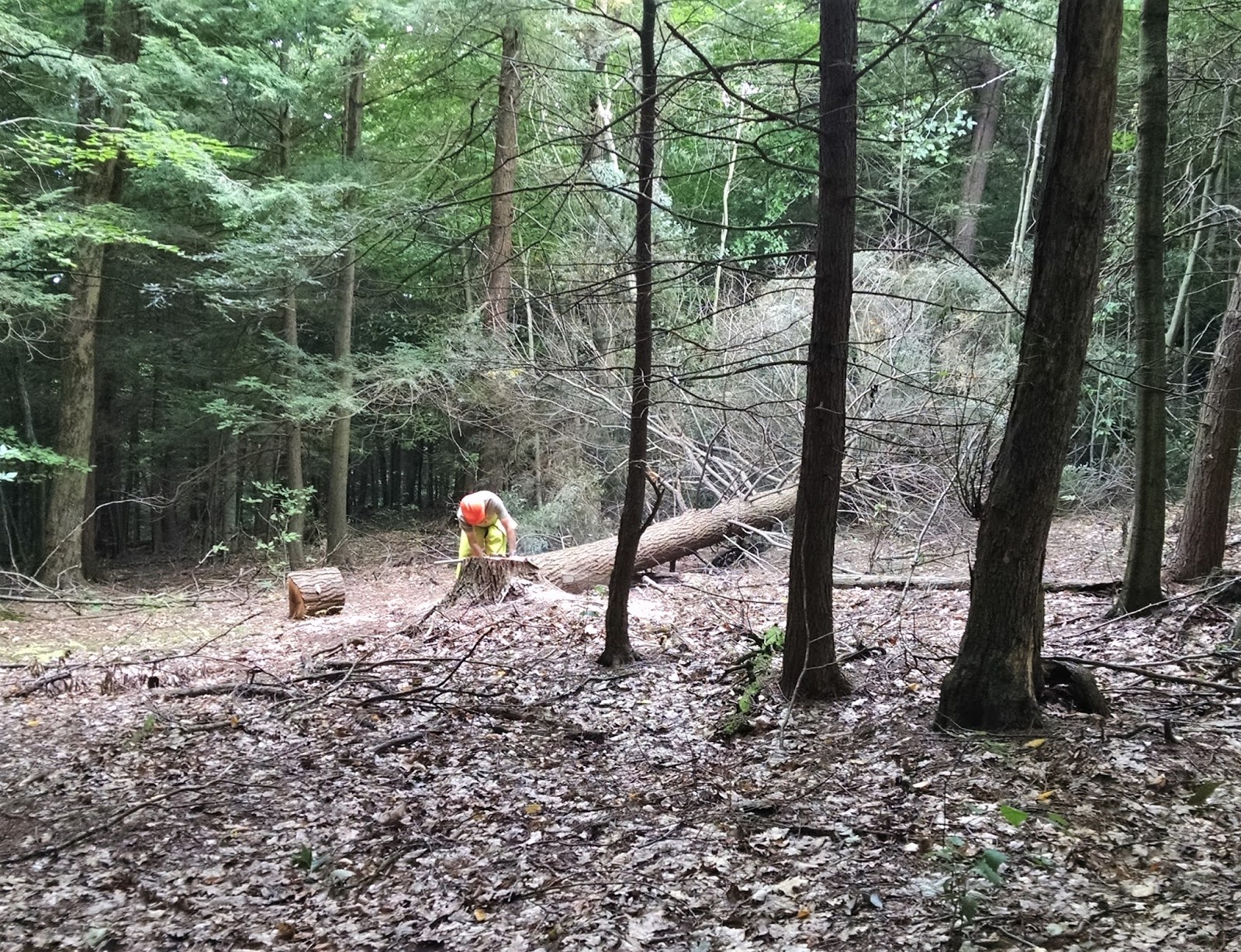

Holly loves to walk up the length of each downed tree.  Such a silly girl.

"Nope, no squirrels in this one.  Let's cut another one down and look!"

The sheep are currently going to the farthest pasture to graze everyday.  They are having to work for their vittles this summer.  There was barely enough regrowth to let them go back there and they spend a lot of time grazing to get what they need.  No lush mouthfuls they can fill up fast on.  We did offer hay in the bunk when they come in at night but they were not enthused so they aren't that hungry but we'll have to move them off that pasture again very soon.

We let them out of the yard in the morning and they follow Andy across the smallest pasture behind the barn.....


.....through the gate and down the hill.....


....and spread out down by the woods for the morning.  They are hard to see - click to biggify.


We have a separate group of old and infirm animals and they go out into the closer, flat pasture that heads north.  Pickings are a little better for them out there as there are fewer of them for that area but we keep hay in their mangers in case someone doesn't feel up to trekking out and being on their feet for hours.  

All that wide expanse and they stick to the narrow sheep trail and march off to work in single file.


Even old sheep have a good work ethic.

Sunday, August 9, 2020

Hot And Dry

Late June and early July offered a stretch of great hay weather - hot, dry days with low humidity and only a few soaking rains which we could see coming and dodged around.  Unfortunately, it has stayed that way.  I love hot weather and look forward to summer more than most people but unrelenting heat with no rain is tough on the sheep and harder on the pastures.  We can manage the flock to keep them in the shade and under fans during the day but no rain just slows grass growth until it gives up and goes dormant.  We rotate the flock through different pastures but for the plan to work we have to have regrowth in the pastures they leave so there's something to come back to later.

Right now they are in the first pasture for the second time.  Normally it would be lush and growing as fast as they could eat it.  This year it's barely half the volume it should be and what's there is almost crispy in some places.  They graze it down and there it stays. 


Most of them are in good shape right now and the pasture includes a lot of clover which is very nutritious but they do spend more time than usual walking around looking for the best areas.


The section in the foreground has just been clipped back.  The farther pasture with the sheep should be much greener with fresh growth.  Not so much.  :-/


The field at the bottom of the slope is the next one they will go to.  It's showing some growth but not much.  Also depressing are all the dead ash trees standing in the woods, killed by the Emerald Ash Borer.  Will ash exist in 50 years or will it go the way of the American Chestnut?  Guess I won't be here to find out.


Andy just finished clipping the pasture they most recently vacated and fertilized it too.  Now it just needs rain.


It's easy to get anxious when something as critical as weather is so totally out of your control.  A good remedy is a walk and Holly is always ready to assist.


Pie helps too, but I didn't have any handy.  ;-)

Tuesday, January 29, 2019

Why Tractors Catch Fire

Continuing with trying to catch up the blog from last year, we bring you a cautionary tale about expecting the unexpected. 

European starlings can easily reach plague proportions on a farm.  They are precocious and prolific breeders and can produce multiple clutches per year.  They eat anything they can get their beaks on, they aren't shy around people or activity and they are cavity nesters so their chicks are more protected from predators and environment then other birds.  Populations build quickly.  And the more numerous they are the more creative they become in finding nesting sites.  We've had them plug chimneys, grain elevators, downspouts, the eaves of buildings, the elevators of corn pickers and the horns of forage choppers with nesting material.

Last summer Andy climbed on one of the tractors to start it and nearly had a heart attack when a starling flew into his face from a narrow gap next to the throttle lever on the dashboard.  The tractor had been idle for a few days....

Removing the hood over the engine revealed what the bird had been up to - nest building way up toward the nose of the tractor.


In just a few days the starling had investigated and found the spot acceptable despite the smell of diesel and oil and metal, dragged all the material in for the nest and laid a clutch of eggs.  Thankfully they had not hatched so we weren't faced with a quandary of what to do with live chicks.


Quite the feat - the gap it entered is just to the left of the levers with knobs and the route goes behind the dials, then up and along the length of the tractor, under the metal arch that holds the hood rigid and to a void.  How many trips did it take to fill the space with enough material to make the nest?


Andy was in up to his elbow clearing it and took a good peck basket of dry grass and twigs out of the gap.  You could hardly ask for more combustible material.


Disaster averted, thankfully.  I wonder if the insurance agents have heard 'fire from bird nest' before?

Saturday, August 11, 2018

More Livestock

It's that time of year around here - Monarch butterflies are in the air although not in the numbers I remember from years ago.  Their population has been in decline for some time and apparently there are people - legions of them - who work to help Nature by raising the caterpillars and releasing the adult butterflies.  My friend Amy the Fibergoddess from Stone Edge Fibers collects young ones and raises them every year and she inspired me to do the same.  (She also pointed me to a great facebook group - Raising Monarch Butterflies.)

We have an abundance of milkweed and it's actually an invasive weed that farmers try to keep out of their crops.  Not only does it spread by the pretty, fluffy parachute-like seeds that the wind carries but roots send up new shoots and can remain viable underground even after some herbicides have been used in an area.  We see it growing on the edges of fields and in fence rows and have several large islands of it that have sprung back with vigor in alfalfa that was cut in June.

Mortality in the caterpillars in the wild is pretty high.  Despite being nasty tasting, which is supposed to discourage birds, they are preyed on by other insects and are subject to viral and bacterial diseases just like all other living things.  Caterpillars fend for themselves so taking them from the wild and raising them to adulthood doesn't interfere with any family/pack/flock social structure.

I carried a small Tupperware container with me while walking Holly and found several to adopt!  The bigger ones were set up in an empty plastic dog biscuit container with the lid altered to have mesh on top.  I broke the tops out of some plants in the field and stood them upright in the container.  Everyone seemed very content.


I also found an egg on the underside of a milkweed leaf.  They are very small - the size of a grain of salt but smooth and barrel shaped.  I put the leaf and a couple very small caterpillars (cats, as the 'professionals' call them) in a Tupperware container with the lid snapped on.  Opening it a few times a day gives the littlest ones sufficient fresh air and also keeps the humidity up for them.  In just a couple of days the egg hatched.  That's the newly hatched 'cat', on the leaf below 'Liberty'.


I put the containers on the sill of a north facing window.  They need light but I didn't want to put them in direct sunlight.  At night they go into the breezeway which is a secure 'cat free' zone (Real cats!) so mayhem doesn't occur.  I put sticky notes on the lids to remind myself how many residents each container holds.


It didn't take but a couple of days and the largest ones were looking for a spot to make a chrysalis.  I moved them to a larger container with mesh over the top.  They promptly crawled up there and made the change.  Tactical error on my part - now it's hard to move the mesh top without disturbing them.  Live and learn.


As other cats matured and started looking for a place to make the change I let them stay in the container they were housed in until they picked a leaf to stick to.  Then I plucked the leaf and clipped it to a bare branch I had set in the big container.


Once they pick their spot and make a "J" I'm certain they will stay put and change.


By this morning I was up to ten chrysalis in the big tub and the very first, oldest one (about 2 weeks old at this point - note to self, keep better track of how many days the various stages take) had turned clear and I could see the black and orange of body and wings, albeit all scrunched up.  By afternoon the butterfly was out!


After letting it rest and stretch I moved it - him, it's a male - to a goldenglow blossom to finish his butterfly exercises.


At the moment I have nine more in chrysalis, three mid-sized cats and three eggs that I just found today.  Reading some of the facebook posts about things that can go wrong with them is dismaying but so far they all seem to be developing normally and it's satisfying to see the milkweed leaves being devoured and the caterpillars growing.  I can manage a seasonal increase in the livestock around here when there's a happy set-you-free ending!  And maybe it will help them recover just a little.

Sunday, July 22, 2018

Providence

The old locust tree by the front door has been a source of worry for some years and we considered having it topped a few years ago when the others around the house were done.  We I was too sad to think of all of them being reduced so much so we didn't trim that one.  This spring we revisited the idea.  The honey bees hadn't survived the winter and it seemed like a good time to bite the bullet and do it.  We called our tree guy but he didn't get back to us and we let is slide.  Then new bees moved in to the tree and we didn't press the matter. 

Last night a storm front came in with wind and rain.  Early this morning, after hearing a gawd-awful WHUMP we looked out the front door at this.


The rain system came in on an east wind which is unusual for the summer when the tree is fully leafed out.  Wind plus wet leaves plus age equals destruction.  How bad would it be when we really went out to look?


The broken section miraculously fell exactly in the only place it could and not cause major damage - squarely in the narrow area between the house and garage.

It did break a modest branch off the flowering crab next to the garage but it never touched the nice wind chimes that were a gift just recently.


Quite the mess.


It was literally half the tree and nothing we were going to clean up in a few minutes.


Also, a very large limb was teetering on the edge of the upper storey roof but we weren't about to try to get it off in the wind and rain.  You can just see the broken stub of it superimposed over the vertical trunk of the standing tree.


What about the bees?


The front of the tree looks pretty damaged but the crease where they fly in and out wasn't much affected.  There were a few bees walking on the trunk but it was raining and barely sixty degrees so one would hope the quiet normal behavior meant no big disturbance in their world.

Sometime during the morning while we were doing other things the big branch took itself off the roof and somehow rolled or twisted out and away from the house and windows.  Again, there was an amazing lack of damage.  Even my garden gargoyle suffered no harm despite the tree trunk coming to rest just nudging his wings.  I think he should have had his hands over his head at this point.


The afternoon brought sun and a chance to clean up.  We still marvel at how the tree missed everything important.


Andy nibbled away the leafy branches first with the chainsaw and I pulled them away into a big pile for removal later.  Once he could reach it, Andy got the tractor bucket under the broken trunk and lifted/pulled it off the porch railing and could cut it loose from the standing tree.


Once the sun came out and the air warmed up the bees became very active and worked busily going to and fro as though nothing had happened.


Our friend, Red, came over and helped and it really went very quickly.


The profile of the yard is quite different and it will likely change again soon.  Our tree trimmer got another call from us today and he was here this evening to look over the situation.  He doesn't see a problem with topping the remaining tree and will get to us as soon as possible.  For now the tree looks like this.


And we are counting our blessings!