Showing posts with label construction. Show all posts

Tuesday, September 29, 2020

Fall Has Fell

 Despite the hot temperatures there is no denying that Fall is truly here.  I thought the drought would impact the color change in our foliage and trees would yellow a bit and then drop their leaves.  Just the opposite is true and we've had the best color display in some years.


The fall flowers are blooming much more heavily that I would have thought possible given how water starved the plants have been.   The view across the neighbor's property down the valley is a river of goldenrod.


The sky is clear, unbroken blue day after day.  We did have one afternoon of wispy mare's tails which normally mean rain but we didn't get any.  I think this one looks like The Nexus (skip to about 1:10) and given the strangeness of 2020 I wouldn't have been surprised if it had been.


The weeds wildflowers in unkempt corners are making me glad I didn't spend a lot of energy cutting them down earlier this summer.


Even humble ivy that's crept up trees and along the ditches has turned brilliant red.


Normally the sheep would still have been out on pasture for a few more weeks but we had to bring them in and start feeding hay four weeks early.  We made enough of our own for a normal year but we didn't have enough for extra weeks of feeding.  We were lucky enough to secure 20 big square bales and after an initial trial of three bales - which the sheep were delighted with - we had the rest delivered.


Keeping the flock off pasture requires a different daily routine including scraping the barnyard area clean every morning.  Here, the girls seem to be giving our effort an inspection.


We left the auto waterer in the feed bunk to encourage exercise and because the chore of rerouting water into the barn isn't really necessary until freezing temperatures start.  Fortune is looking longingly at a kitty that she really. wants. to. sniff.


Another aspect of feeding hay is the need to coat the flock to keep the wool clean.  Thus began the annual Washing of the Coats.  I do about a dozen a day and triage them after they are dry for holes and weak leg straps.  Soon there will come a day of mending.


We don't normally need to keep the sheep cool AND in the barn but this year with a week of mid-80s predicted we knew we'd have to take some kind of measure to keep them comfortable.  When we used to have a building full of ram lambs in the summer we had a large box fan going for them but it hadn't been needed for a few years.  Time to press it into service.  First Andy had to create a 2X6 the right dimensions to support it.  The buzz rig was pressed into service as a big table saw.


This will move air!


Mounted where it is, at the end of the pens, a good flow of air will move the length of the barn and push stale, warm air out the south end where the rolling door is normally open. 


Holly sez:

"Bleah.  It's too hot and bright out here.  Let's go in for a drink."

Dogs are so sensible.


Wednesday, February 8, 2017

Nursery Furniture

One can never have enough equipment for handling sheep and sometimes you really NEED more equipment.  Brian Magee, the gentleman who used to shear our sheep is also a shepherd himself and operates his flock using the Star System which he and Doug Hogue designed when he worked at Cornell University.  This system breaks a breeding flock into five groups which lamb in a staggered sequence around the calendar and evens out lamb production so one theoretically has lambs ready for market several times a year rather than one seasonal glut in the fall.

Anyway, Andy had built Brian some folding panels a while ago with which to make temporary pens. They functioned so well that Brian wanted more, plus a couple of creep gates and creep feeders.  He picked up eight of the bifold panels......


Three of the creep gates (the horizontal bar keeps ewes from trying to wiggle through and can be raised as the lambs grow.  Lambs can slide through a narrow opening but it's harder to crawl through a low space)....


And three grain feeders.  The bar across the top is plenty high enough to allow them to eat but keeps lambs from easily standing in the feeder and fouling the feed.


It ended up being quite a load for the little trailer Brian brought but the guys got it strapped down for safe transport.


A great many lambs ought to benefit from safe and sturdy surroundings.

Saturday, June 13, 2015

Life's Messy - Clean it Up

That was the slogan of some paper towel brand many years ago.  If only some messes were that easily taken care of.

The pillars of silage left behind when the Mennonite folks took down two of our silos were still here this spring - sadly, no magic snow fairies whisked them away during the winter.  Andy was able to remove some of it with the tractor bucket last year but the concrete staves still embedded in the ground were reinforced with metal rods which would puncture a tractor tire faster than you could say "Oh, $*%&$!" if you ventured over them.  We needed something with a longer reach.

Thankfully, the neighbor who installs fence also does backhoe work and was available (due to heavy rain making a swamp of the fence job he was working) to come and dig the old silage out and load it on the dump wagon so Andy could then discard it at the edge of the woods. It will rot down quickly - the loads he took there last summer were already hardly noticeable.  What a pleasure to see the big job be done so quickly and with such a masterful hand!


There was two days worth of digging here.  It was amazing that the silage in the very bottom was still pleasant to smell.  I don't know if animals would have wanted it but it was a nice surprise to us that it wasn't foul to work around.   You can see how far down he was reaching - that void will have to be filled and the ground graded and seeded. 

When he was done he loaded himself back on the trailer.  It made me think of a hen settling herself down on a nest - careful approach, shimmy a little to get just right, settle down.... ahhhh.  (I have no idea what those buzzing sounds partway through are - maybe that mothership trying to contact me again.)


Better...... I guess.  It looks pretty naked and shabby with circa 1964 sheet metal and unpainted wood exposed for the world to see.  


Eeesh, it doesn't exactly enhance the look of the place but at least now Andy can reach the building to start to dismantle it.  First though he has to fill those craters left by the removal of the spoiled silage.  We have a very large mound of mixed stone left from the reclamation of the gas well drilling area and that will be put to good use here.  (Well, some of it - it's a very large pile).  But the silage is gone and that's a good thing.

One more chunk of a very big job done!

Wednesday, April 29, 2015

Shamelessly Using Lamb Cuteness

....to make up for lack of narrative.  We've been occupied with finishing shearing the flock, sending wool out for processing, getting fleeces ready for the Maryland show and generally taking care of everyone.

Andy did finish building three creep feeders for a fellow shepherd.  These are free-standing and can be moved but are designed to stand against a wall.


They are deep enough to hold slices of hay and slanted at the front so the hay will continue to drop down as it's eaten (and also hampers little lamb feet from standing up against the grid and reaching over the top).


The bottom of each feeder is solid to catch hay fines or a grain ration and the lip in front will keep good stuff from being rooted out onto the floor.


The lambs here are growing well and doing all kinds of cute lamb things.  The gray one on the right was racing across the pen, accelerating into a blur like The Flash.


These two little boys were starting to play at head butting.


There's the 'bouncing around together in a group' event.......


About half way through, notice the white guy that jumps so hard he falls down.


Everybody chews on hay, either for real eating purposes or just for something to do.

And the older ones have started to chew a cud. (Sorry this is grainy - I tried the zoom function on the phone).

And we've finally had some sun and warm weather.  


If there were room and time I'd join them!

Wednesday, July 2, 2014

Waste Not

 
"Use it up,
Wear it out.
Make it do
or do without."
 
That particular bit of wisdom was my Great Aunt Martha's favorite.  Born in 1892 she grew up in a time when waste was shameful (as well as stupid) and the need to be frugal was reinforced by the first and second World Wars.  I was small when I knew her but I liked that bit of rhyme and have always remembered it.
 
Processing wool through a carder to make roving always generates some waste - short and broken fibers that fall from the carding cloth and are discarded.  I've always been annoyed by the reality of having fiber that I've spent time skirting and washing and dyeing end up being thrown away even though it isn't a great quantity.  But no more!  I'm a bit slow on the uptake but have finally caught onto the thought of making dryer balls from the waste.
 
Behold!
 
 
I've asked Diane from Acorn Works to return my carder waste to me along with the good roving.  Thanks to a tutorial from Thecrazysheeplady I have turned several bags of fiber into dryer balls.  I made seventeen in the first go 'round and I have more fuzzy waste fiber yet to use. 


I had a little trouble keeping the size consistent and the bigger ones were a little too squishy so I got the bright idea of cinching them up with yarn and letting them have another wash cycle. Then I threw them all in the dryer to beat the fuzz and dust off them and round off the lumpy parts.  The yarn worked to help them tighten down but what I thought was a fun little pattern of yarny dashes ended up looking like the big cartoonishly obvious stitches that hold Frankenstein's head on.  Oh well, they are functional and turned my waste fiber into a useful item so I'm hooked.
 
Totally unrelated, we have cliff swallows nesting in one machine shed!


I love these little guys!  We have barn and tree swallows too so the flying insects had better watch out.  The barn swallows make a mud nest with a traditional cup shape, the tree swallows are cavity nesters and have camped out in one bird house in the big rose bush, but the cliff swallows don't settle for some simple nest - they make a mud structure that's totally enclosed with just a little entry hole.  And they were smart enough to settle in the one building that the cats frequent less than the others.  Coincidence or are they a bit smarter than the other species of swallow?  Maybe elaborate nest structures are correlated to intelligence?  Sounds like a thesis paper for someone.....
 
Speaking of building, I saw this paper wasp industriously gnawing on the wood door frame of my wool shed.  You can see from the parallel chew marks in the wood that this is a favorite place to come get building material. 
 
 
After scraping wood fibers from the board he mixes it with spit to make a pasty pellet and then carries it to the paper nest and applies it to the leading edge, using his jaws to shape it into a thin flat strip - building a sheet of paper one mouthful at a time. 
 
 
I'm always amazed by the abilities the good Lord gave all his creations, even the little ones.


Saturday, November 9, 2013

Done! Sorta....Well... Not Really

Late yesterday as the Hoovers were finishing work on the second silo it started to spit snow.


They had removed the scaffolding when it was no longer helpful and could finish while just walking on the surface of the silage.  For some reason there had been a lot of staves at the top of this silo that were more fragile than the others had been and they broke in the process of removal.  If they broke cleanly into two or three big pieces they were gathered up and stacked together for later repair.  When the silos are erected in the new location the new owners will have the inside ShotCrete-ed for strength and that will hold the pieces together like super glue.  Still, there were a lot that weren't salvagable.  As it worked out, the best place to put the rubble was on top of the silage pile.  It's not underfoot and when Andy gets time to start cleaning this area up he can just lift the front end loader on the tractor and toss the bits in.

I had assumed that they would stop taking staves when they reached the silage or maybe one layer down.  Not so!  They continued pulling them off right down to the ground. 


The column of silage has the consistency of plywood on the outside and shows no sign of collapse.  I'm sure it would slump over time but if plans work out as hoped there won't be an opportunity for time and wet weather to work on it.


We're pretty sure it's timothy haylage.  One unexpected delight is that it still smells like nice silage!  Hard to believe after all these years but there has been little deterioration where the forage was pressed tight against the silo wall.  I expect the scent will wear away soon but what a pleasure to smell sweet and tangy silage again. 


There has been some rot at the base of the silo on the side that faces the barn.  Here the silage just crumbles without support.The staves had been eaten away to the point that you could stick you flat hand under and between a couple.  This was a chief reason we really, really needed to address removing them sooner rather than later.  How much better to take them down than pick them up.  :-O


A daunting accumulation of staves on pallets waits for transport.  They said a tractor trailer would likely be here at the end of next week to pick the all up.


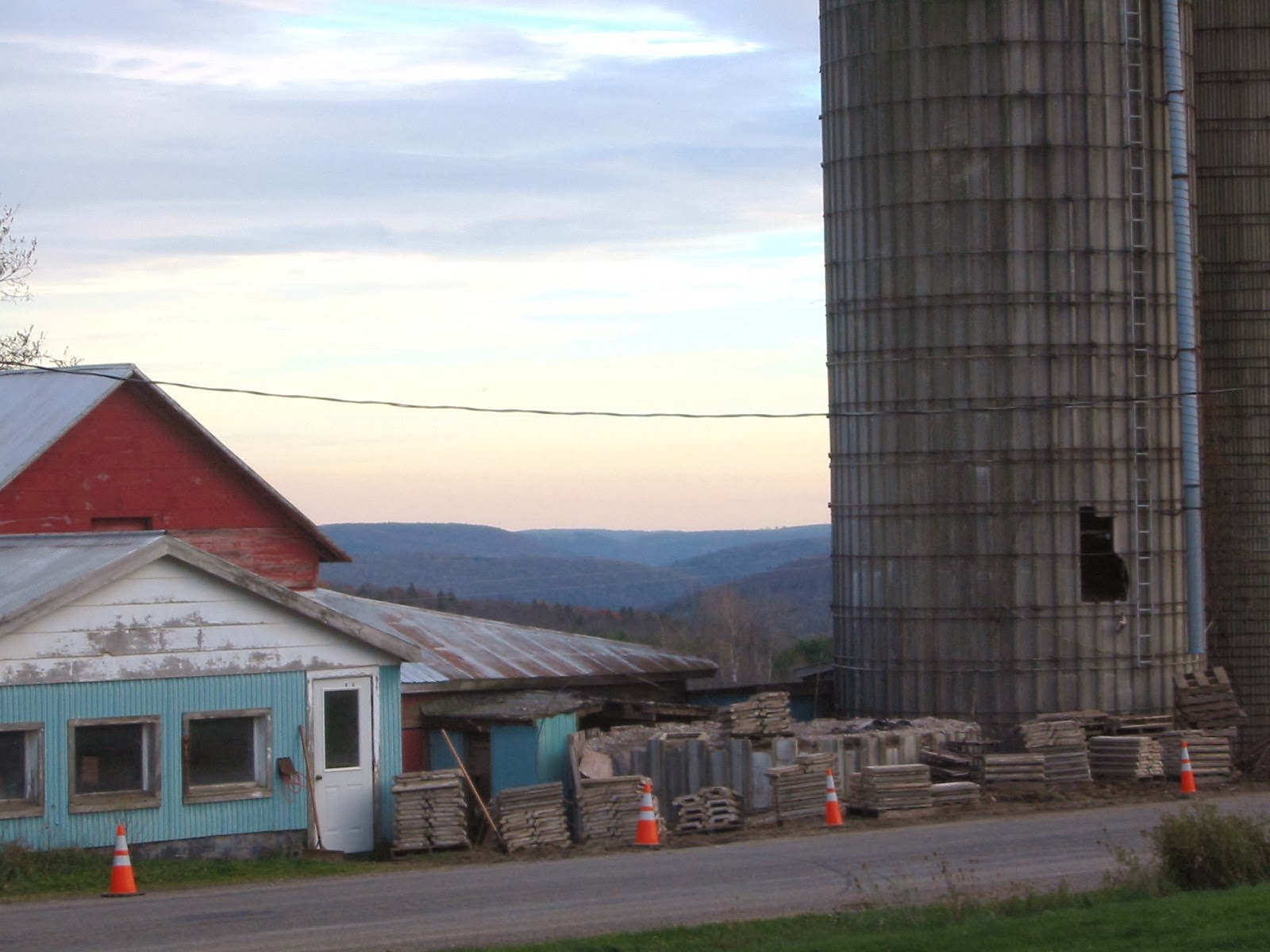
We're going to leave the caution cones up till they are removed.  We've never yet had anyone veer off the road here (that we saw!) but I'm pretty sure a car would come off the loser in an encounter with these. 

So for now it's back to our regular work - cutting firewood and working with wool - but with thoughts running through the back of our minds about when clean up could reasonably start and how best to address filling in the craters and fixing up the barn. 

I think we're not done yet.

Friday, November 8, 2013

The Second Silo

The Hoovers rolled in promptly at nine o' clock yesterdat morning.  No small feat since they undoubtedly fed and milked the cows, fed the young stock, cleaned the barn, eat breakfast, loaded up tools and additional people and then drove over.  It dawned on us as we talked with some of the men that they switch out helping for one full day.  Seems like a good system.  Everyone helps the person whose project it is by contributing labor for one day but nobody has to neglect the work at home for more than a day.

First task - removing the hoops and roof of the silo.

 
Then the filler pipe and exterior ladder.


View from the back side of the silo as the first course was taken off.    Note that the silo next to it has a metal and fiberglass ladder chute.  Different choice of materials by a different maker but it serves the same function.  Besides being a safety measure, the chute gives you something to brace your back against as you're standing on the ladder and using both hands to manipulate a wooden silo door.

 
The man on the right is reaching down and removing the bolts on the hoop below him so it will drop to the ground and allow them to remove the next course of staves.


Dropping staves......


They didn't quite get done with it today. And there will be a very large load of staves on pallets to take away. I'm very glad I'm not the one who will have to drive the truck down the hills of Prattsburgh!


Wednesday, November 6, 2013

Going.......Going.......

The Hoovers pulled in bright and early this morning to continue work on the silos.  We put the largest group of sheep, the non-breeders, out to pasture to prevent the frightened meltdown that surely would have occured if we had tried to keep them in the barn and yard today.  Fortunately, the weather was lovely for them.


The first order of business was to remove the secondary hoops on the lower half of the silo. Many steel hoops completely encircle the silo with extras on the bottom.  The lower section bears the brunt of stress when the silo is full.  Think of all the downward pressure from the weight above.... the pressure to burst outward is enormous so the steel hoops are essential and they double them up on the lower half of the structure.  An empty silo isn't under that pressure so some of them can come off.  It also speeds the process if you take some off before getting started.

 
When the hoops are applied during construction they are tightened in place from both ends at the same time with the help of these clever little connectors.  Tighten the two nuts and the hoops contract.


Sections of hoop gathered for transport.


The men quickly began work at the top of the silo - tap the staves with a sledge hammer to break the light mortar seal, wiggle them free and drop them one at a time to the pile of loose dirt below, yelling "Stave!" as each one falls.  This view from the back of the silo shows the concrete chute enclosing the ladder used to access the wooden doors in the silo wall.  You can just see an empty door frame at the top of the chute.  Actually, in an economy of material, the ladder in the chute consists of rungs built into the wooden doors.  Each door has two rungs and when they are fastened into the door frames they create the ladder.

 
Here about five courses have been removed and neatly stacked on pallets for transport.  Each stave weighs 72 lbs, so for a silo this size the staves alone weigh 40 tons.  Then there is the weight of the unloader and all the steel hoops, the roof, wooden doors......it will take several trips with the big flatbed trailer to move it all to the new "home".
 
 
They brought their own skidder with them for moving pallets around.


Tires modified with steel cleats to keep in contact with the ground.......

 
We kept checking on their progress through the day.  Here they are about half done with the first silo.  You can see a stave in freefall almost in the middle of the silo.  There is a crane arm on the scaffolding (pointing to the left from the top of the silo) and it's used to pull staves up when a silo is being built but for deconstruction they choose to drop the pieces into soft dirt.  It's faster.  They did use the crane to lower wooden doors and the more fragile concrete door frames.  Those are built like a picture frame and wouldn't survive the landing if dropped.


They worked steadily through the day.  I had some errands in town and then worked on fleece in the wool shop.  Andy spent some time dealing with the corn picker.  It will be pressed into service soon and needed bearings and some other parts replaced.  Of course you can't just reach in and get that one part, you have to take a whole lot of other parts off first.  And remember the order they came off in.


Almost down to the level of the old spoiled silage (plus several inches of pigeon dung.  Ick.)


Finished with that silo except for some picking up of small parts.  Now they're using the skidder to lift the scaffolding parts into the next silo.  They did get that erected inside before they were done.  You can count on their quitting time - they have to go home and milk the cows.


Done for the day.  Stacks of staves on pallets waiting for transport.


Wooden doors stacked to be loaded.  See the two metal rungs?


The road supervisor lent us some orange caution cones to use along the road.  The Hoovers were very neat and careful.  We barely scraped a wheelbarrow's worth of gravel off the road's edge.  Call me goofy (and it wouldn't be the first time.  Heh.) but there's something very pleasing about watching a team of men labor well together.  No screaming at each other, no confusion, no conflicting directions about how to proceed.  They worked quickly, smoothly, neatly and with no casual four-letter language being shouted into the wind (unless it was in Pennsylvania Dutch - I guess I couldnt' say for sure.)  Anyway, it was a pleasure to watch them and it gives us good vibes about the silos' next life.  The silos do represent the way we lived a large chunk of our lives, especially Andy, and it's hard enough to see them go from the landscape.  At least we know they are going to be used by people who live as we lived.


One silo gone except for the base and spoilage that we have to take away.  And look at the view that's opening up!  :-)


Wow.