Showing posts with label festival. Show all posts

Friday, June 28, 2019

Maryland Sheep and Wool Festival From the Vendor Side

What a busy and cold, wet spring!  The weather has hampered everything from cleaning the barn to doing field work.  Andy and I have been doing a lot of shop work, turning wool and wood into spinning fiber and tools.  We have a full spring festival season mapped out and need to build inventory so the shelves stay full.

The biggest festival of the season is the Maryland Sheep and Wool Festival, and Nistock Farms was a vendor there for the first time.  We were accepted into a tent space in the upper gravel lot, but being in a tent gave me pause as I know how wet it can be there.  Setting up on gravel felt as safe as possible though, so off we went with great optimism the first weekend in May!

Julie and I drove on Thursday so that we'd have all day Friday to set up.  New space, new dimensions, uneven floor.... we knew it would take a while.  Here was our home for the next two days.


I was alarmed at the lack of sidewalls, especially since it was raining and foggy, but was assured that the tent company would be back at some point during the day to put them up (and they were) so we forged ahead with unloading.

"Trailer full of heavy stuff?  Sure, no problem!"

Our tent walls were clear, thankfully, and despite not having electricity it was quite bright inside, even on Sunday which was raining and dreary.  With the tent wall pulled up to function as a door we looked inviting with sort of a bedouin flavor.  ;-) 


We are a fiber provider of Cotswold for the Livestock Conservancy's 'Shave 'Em to Save 'Em' program which works to connect fiber artists with the producers of rare sheep breeds' fleece.  We had raw Cotswold available by the pound, prepared roving and Cotswold yarn so we had all angles covered and sent a lot of folks home with wool from a breed they had never sampled.  Awesome program, Livestock Conservancy!


One happy shopped discovered that we had the same taste in colors - I had created roving that matched both her blouse and her shoes!


We made one purchase prior to the festival season and ordered the grid panels and hardware to construct a free standing "H" shaped display.  Andy had cut some nice shelves and it functioned well for small, lightweight items. 


The far wall displayed yarn and our Cotswold blankets and then there were two tables and upright grid wall for Andy's fiber tools.  I spent a fair amount of time demonstrating Oxford rug punching and punch needle embroidery, both of which are easy to do and the Oxford rug punching has the added allure of being able to eat up handspun yarn - a plus for spinners like myself who have totes full of yarn with no specific purpose.


All in all, the tent space worked out well and I've already signed up for next year.  The major downside of being a vendor is that it's tough to get out of your booth and see the festival!  Spinning guild friends stopped by to say hello (don't know where the group hug picture went, darn it) and my only trip to the sheep barn was on a mission to steal some electricity for my phone.  Not ever having dealt with a non-electric booth I didn't think about phone battery life - and one needs it to process credit cards.  Yikes!  Thankfully I was able to park my phone in the sheep show office and bring it back to life.  First purchase upon returning home - a battery pack with USB ports for just such situations.  Apparently the world has been using these for some time and once again I'm firmly behind the technology wave.  :-/

I was really sad that I didn't get a chance to peruse the display of fleece types.  Apparently there was an extensive collection of breed samples including the rare and foreign and I should have found time to see it.  I hope it might come back another year.  One event that I did manage to get to was the Skein and Garment display and that was because the festival committee members were generous enough to keep the building open for one hour after the festival closed so that vendors could enjoy it.

As usual, the talent and artistry was astonishing.  Every entry deserved a photo but I grabbed a few of the items that most caught my eye.

Knitting...


Photography and graphic arts.....


Thecrazysheeplady's wool house image earned a blue!  :-)

Amazingly realistic felting.....


Items that are both artistic and functional......

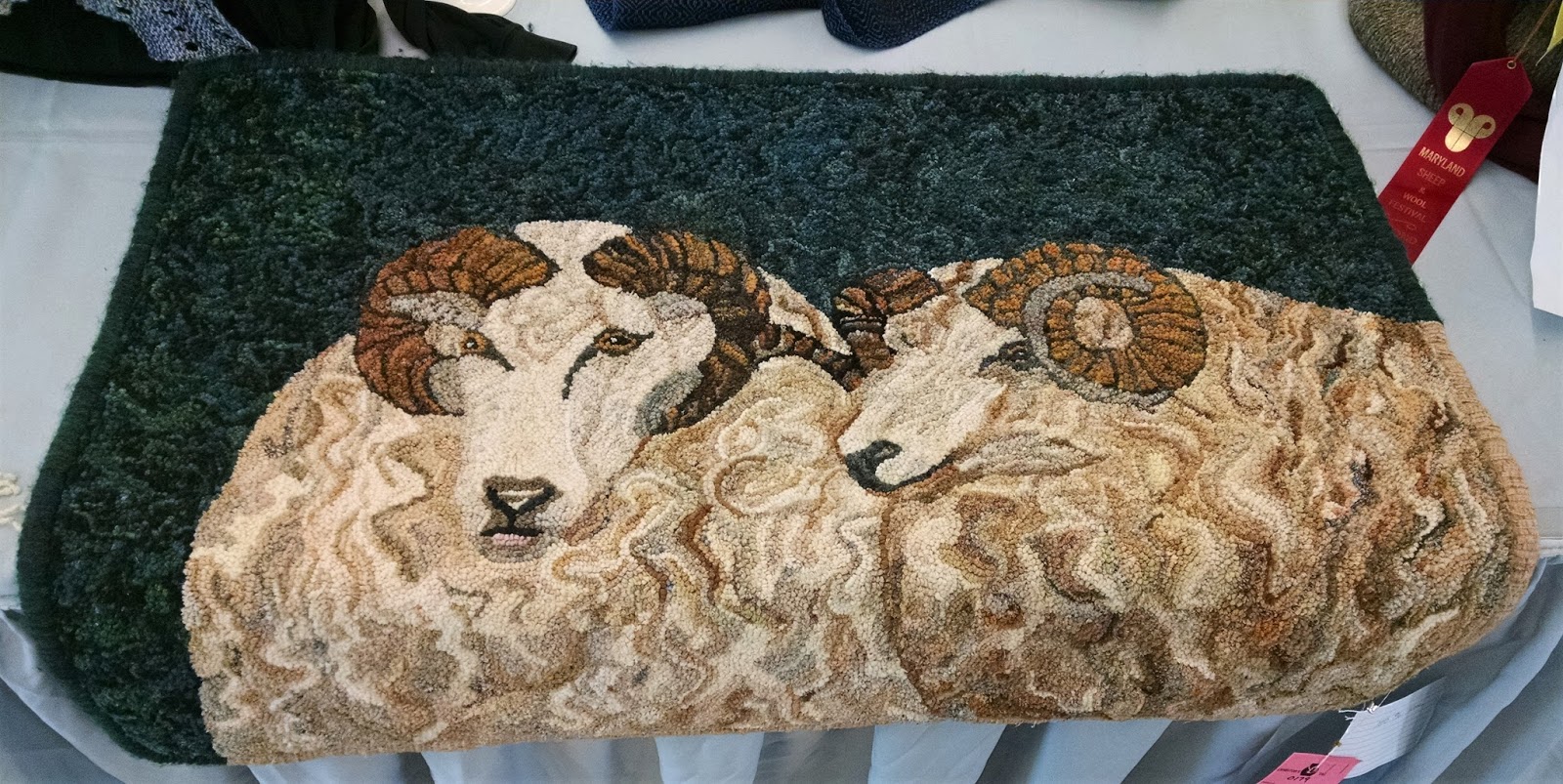
I don't remember if this was hooked or punched but the design is the artist's original.


And my favorite entry.....

The Travelling Fleece.  A 'handspinner's basket' entry featuring wool spun from Buddy, a sheep from our flock who moved to Equinox Farm at a tender age and lived a long happy life there.  Buddy's sire was British (thank you, artificial insemination technology) so England, New York (our farm), Kentucky (his lifelong home) and Pennsylvania (where the spinner worked her magic on the fleece) are all involved, hence the 'passport'.  How clever is that?? Far beyond what I could have come up with and very worthy of the blue and purple ribbons adorning it.


Having been initiated to the rhythm of being a vendor at such a big show I will be better able next year to plan some time to get out and see more of the events, even if it has to be 'after hours'.  That's one of the fun things about such events - the sheep barns never really close!

Tuesday, May 29, 2018

Pilgrimage - Part 3

Somehow I missed including this handsome Herdwick in the last post.  He was on display in the breed barn at the festival.  Not originally raised in the US, Herdwicks are being introduced through a 'breeding up' program of AI using imported semen.  Beatrix Potter, the children's author, was instrumental in keeping the breed viable and made provisions in her will that Herdwicks must always graze land that she owned when living.


While not in the breed barn, these lovely Karakul sheep from Pine Lane Farm made a nice display.  These are youngsters but already show beautiful fleeces and breed type.


And of course a significant part of the festival is the competitive showing of the various breeds and categories of sheep. One could argue that the show ring puts pressure on breeders to select for traits that impress judges rather than always trying to meet a perfect balance of desired breed standards and productivity but in a venue like the Maryland Sheep and Wool Festival it may be most important that a given breed gets exposure to potential new shepherds.  Many people contemplating sheep don't get to see representatives of a breed they are considering except for shows such as this and certainly not in these numbers.  The right breed for your farm plan, the right fiber for your project - at this festival you will likely find options you didn't even know existed.

How do sheep shows work?  Within each breed, classes are broken into genders (rams usually show first) and within each gender there are classes by age - yearlings, senior lambs and junior lambs.  In each class animals are placed first, second, third, etc.  When classes in each gender are concluded the first and second place animals for each class come back to be judged against each other for Champion Ram (or Ewe).  It's possible for a younger animal to be a better specimen than an older one, so you could have the first place senior ram lamb named Champion and the first place yearling ram named Reserve Champion. It sounds confusing but it's quite orderly once you watch the process for a while.

The big show pavilion at Maryland is divided into two rings and so two breeds' shows can be going on at once.  It can be a challenge for shepherds if they are showing more than one breed since they could need to be in both rings at once!  This is where sheepy friends step in and help show animals when there just aren't enough hands to be everywhere at once.  I've found sheep producers to be really generous this way - it's a competitive situation but we are all in it together so everyone helps when needed.

Pens around the show ring area are used to hold animals while they wait for their class to occur.  If one has eight or ten sheep in a breed show it doesn't make sense to keep running back to their barn through throngs of people to swap entries.

These sheep are waiting for their classes in the Black Romney show ('black' meaning colored/not white).


I'm always happy to see so many kids involved with showing sheep.  Having grown up on a farm I am probably biased but I think that you learn a great many things handling animals that you just don't grasp no matter how earnest and involved your parents and school teachers are. It takes a degree of patience, empathy and responsibility that you don't acquire unless live animals are involved.   I was particularly taken with this little girl in the white shirt and tiara (who I later found out was six years old) and her confident manner.  I had seen her earlier handling a white Romney who was pretty rowdy and actually knocked the child back onto her butt.  She had never let go of the halter, popped back up like nothing happened, didn't get flustered or mad at the animal, just took it in stride and carried on.

In this case she is both watching the judge and checking to see how her lamb is standing compared to the nearest competitor.  An adult is setting the lamb's back feet for her but then steps back and lets the child do the showing.  Kids like this will grow up to be confident adults who achieve much.


This is what it's like to sit in the stands and watch.  The White Romney show is in the near ring.  The far ring holds Black Lincolns.


When the judges have finished evaluating the animals and made their placings they will pick up the microphone and explain to the audience and exhibitors why they made the choices they did.  Good judges will try to comment on more than the top three animals if there is time but sometimes they have to keep the talking to a minimum for the sake of speed.


Every sheep show venue is different but Maryland is right at the top of those events for breed diversity and animal numbers.  If one has any desire to learn about sheep and wool and all the products and uses thereof, make the pilgrimage to the Maryland Sheep and Wool festival!


Tuesday, May 15, 2018

Pilgrimage - Part 2

As wonderful as all the vendor goods and competition items are, the real stars of the Maryland Sheep and Wool Festival are the sheep!  The festival has stayed very faithful to promoting only sheep and wool at their event.  Since the Maryland Sheep Breeders Association is the main sponsor of the event and they don't want to dilute their promotion with other species it makes perfect sense.  I did see some fiber bunnies in the Demo Area and a pair of alpacas near the Skein and Garment building but that was it - everything else was sheep-centric.

The Breed Display Barn is a swell collection of common and uncommon breeds here in the US.  If you want to research which breed would fit your farm/fiber business this would be a great place to start.  Breed association info (including producers) were available at each pen and a display of wool and wool products helped to teach what each breed was designed to do.

The Border Leicester display always blows me away.  It's similar but different each year.  I admit I was so amazed by the wool display that I didn't take a picture of the sheep.  :-(


Some of the more uncommon breeds that caught my eye this year were:

Clun Forest - These medium sized sheep are a good fit for smaller homesteads.  Easier to manage that some of the very large breeds, they are hardy, very maternal and lambs are vigorous.


This ewe had a pair of twins who were quite young but old enough to travel.  It was really hot on that Friday and the family was exerting themselves as little as possible.


Kerry Hill - This breed is from the UK and has only recently been introduced to the US through an artificial insemination 'breeding up' program.  Starting with an available, similar breed one uses imported semen to produce lambs (the first, "F1" generation which is 50% Kerry Hill or the breed you're introducing) and subsequent AI done on the F1s and their progeny (using more purebred semen) produces 75% then 85.5% then 92.75%, etc pure animals.  This farm used Cheviots as foundation ewes. ( Not sure where the display animals here at Maryland were from but the lamb had very good coloration).


Leicester Longwool - This heritage breed was re-introduced to the US with some purebred sheep imported from Tasmania about twenty years ago.  That was about the time the borders here were closed to live animal import and dedicated breeders have done a great job building distinct flocks from a very tiny original gene pool.  The breed is in the same family as Cotswolds and Lincolns.


Shetland (I think - I'm embarrassed to admit I get them confused with Icelandics) - Small, friendly and coming in a ton of colors and patterns, these sheep are very popular with handspinners and folks who want fiber producing pet sheep.  And these lambs were just too cute to pass by.


And the big draw this year of the Breed Display was the pen of Valais Blacknose Sheep  (OK, two charming lambs) that came all the way from Oregon with Martin and Joy Dally.  Martin has been at the forefront of sheep AI for decades and we acquired our British Cotswold semen from him a decade ago.  These F1 lambs were very well marked and already good ambassadors for the breed as they led well in the Parade of Breeds wearing sweet-sounding little Swiss bells that sang ting-ting-ting as they walked.


They really are pretty stinkin' cute!

Next up - the showring!

Wednesday, May 9, 2018

Pilgrimage - Part 1

One of the most anticipated rites of spring for lovers of sheep and wool is the annual Maryland Sheep and Wool Festival.  This year was their forty-third event and even vast as it's become they have it down to a science.  Vendors, competitions, shows, classes, livestock, food, demos, auctions....every department seems to run smoothly and that adds to the enjoyment of the event.

For me, one of the main events is the fleece show and sale.  I choose different fleeces each year to represent the farm and did well again this year.  Given that there were over 900 fleeces in the event and a producer is limited to entering seven I think that having three place in their classes was pretty respectable.


Organizing that many fleeces into proper groups for judging and sale has become an art form there.  Paperwork is attached to each fleece which includes not just facts like weight, breed and price but other criteria such as coated or non-coated animal, Maryland resident shepherd, member or not of MD Sheep Breeders Association, and other info which is needed when judges are considering fleeces for some special awards.  Of my seven, five sold in the sale, one sold in the parking lot after I had taken it back to the truck and the last one went to a person who had emailed me while I was away and needed just that fleece. 

One of the main not-to-be-missed events (there are many) is the Skein and Garment competition.  This encompasses much more than just skeins and garments - every facet of fiber art that you can think of has a category and classes for entries.  The talent and creativity on display is inspiring to say the least. 

Here is just the smallest fraction of items that were on display.  These first three were big winners and all done by the same person.  Clearly she was given more than the usual amount of talent when born - probably got some of mine and a few other peoples' too. ;-)   Actually I did help a little - the light brown sweater is made from the fleece of a ewe in our flock - Flower.


All items are displayed to their best advantage which isn't always easy given the number of pieces.  The organizers have taken to hanging some things over the edge of the table which actually helps show bigger portions of the item than you could see if they were just folded up on the table top. 


Most of the blankets were hung from rods near the ceiling which saved space and also gave them the room they deserved.


Intricate weaving......


Intricate knitting.......


This woven messenger style bag was complex from every angle and the gloved volunteer held it so that I could show off both the side panels and the big flap over the front.


And another volunteer tilted this framed needle felted rooster portrait so that the overhead lighting wouldn't glare on the glass.  They were all very eager to handle the entries so hidden details could be seen.  The public isn't allowed to touch the articles.

I love this piece.  The rooster is very well done and is framed by actual chicken wire under the glass.  Very clever and  an artistic touch, I thought.


There is a category for educational posters done by youngsters.  It was heartening to see such well done displays.  Even the ones done by what were the real young kids were artistic and informative.  You could tell the children were really "into" making a good poster.


Sometimes the colors in a piece really caught my fancy.


Or they made you say, "Aw, how cute is that??"


And it was hard to resist admiring a piece when it made eye contact with you.


But not all the talent on display was in the competition.  This lady was minding her own business when I passed her on the main boulevard, saw her sweater and pantomimed 'can I take your picture?' 


You meet a lot of good natured people at the festival!

Of course the vendors are another one of the main reasons to attend.  With over 250 vendors gathered in one place you can shop till you drop and still not see everything.  They all want to grab your attention, display something that visually describes what they are all about, and set themselves apart from the others so that you'll be drawn into their booth.  A daunting task in a setting so full of really good vendors. (This is just the biggest building - there were five other barns full of vendors and about 75 vendors in tents on the grounds).


The felted gown and stole that would certainly make a statement no matter where you wore it.


The wall of specialty fabric (this is only a small section) that was heavily weighted with sheep prints but also had every farm animal imaginable and knitting themed prints, too, made you want to sew something - anything! - so you could have the fun of buying the fabric.


Sometimes the wares for sale drew you in when you did a double-take in passing and realized they weren't what you thought.  Drawing?  Painting?


Nope, completely embroidered with a sewing machine guided by hand.


But some booths made themselves impossible to miss, like this one with a nearly life sized felted giraffe towering over the crowd.


Next time - the real stars of the festival!