Sunday, March 22, 2015

Waiting on the.... Oh, They're Here!

Saturday was day 145 since putting the rams in with the ewes.  Gestation in sheep varies by a few days among breeds with 145 to 148 days being the accepted 'normal' range.  Everyone stayed quiet that day - yesterday - so I was able to get to my spinning guild meeting.  Thanks, sheepies!  The 2:30 AM check showed no activity, ditto the 5:30 check, but by 7:30 we had a nice pair of twins already born, mostly cleaned up and toddling around.

 
Mom is a Cotswold ewe named Jolly and the lambs are both rams.  Each weighs 9.5 lbs and are quite active and vocal.  The one on the right was quick to nurse but the other guy was a little slower.  He'd push hard on the udder and baa in a frustrated way but wouldn't. take. the. teat.  As it was only 15 degrees out this morning I figured that was too cold to fiddle around so I striped some colostrum from the ewe and fed him with a bottle.  Getting the stiff plastic teat into his mouth was no problem and once there he would suck - which proved he was capable - so he had a good meal.  He still didn't want to nurse an hour later so I gave him a bit of an enema with lots of "return" and five minutes later I had him latched onto a teat and sucking.  Getting a 'full' lamb to evacuate the bowel seems to trigger the "oh, I'm hungry" response.  I suppose that walking around might eventually stimulate him to 'go' but there was nothing good to be gained by waiting so I helped the issue along.


Mom is being very steady and diligent.  Sooo nice to work with animals that are calm and not concerned about the humans.


One of the two has especially fuzzy cheeks and looks chipmunk-esque.


The other ewes don't show immediate signs of lambing but then again one could decide to start anytime.  There are some pretty wide loads here.


Nibbles has a fun 'do going on - fringey ear wool.

"Good grief, I'm creating the miracle of life here and you think my ear wool is cool?!"

Lovey has cool hair going on.  She's still a ways off for lambing.


Gilly, on the left, appears to have not caught this year.  Since she is 9 this year I likely won't attempt to breed her again.  She'll stay on as a fiber ewe - she has a lovely fleece.


She's always had a strong chin and it makes me think of Chester the Cheetah from the Cheetos commercials.


Besides being barren this year she's showing some age in her eyes - both eyes have a bright white cataract showing in the center of the pupil. It doesn't seem to bother her, or else she's just so good at getting around that we don't see a deficit.


Isabelle is 7 this year.  She's the only ewe lamb I got from doing AI with a British ram.  


She still looks like she did as a lamb, at least to my eyes, but then I'm better with animal faces than people faces.


This ewe is carrying her lamb load lower - a sign that she's getting closer to The Day.


Luellen is still fairly symmetrical. 


Then there is the rest of the flock which I didn't breed.  We only exposed 35 ewes this year - down from my all time high of 79 (when I must have been temporarily out of my mind) - and of the 35 it looks like there will only be 29 or 30 who are actually carrying lambs.  It's OK - we're decreasing the lamb crop by design so I have more time to work. on. wool.  Which was the whole point of my having sheep in the first place!

"Didja hear that?  No multitasking - just grow da wool real good!  Woohoo!"

Large Marge - "Suits me.  I loved my babies but I don't neeeed to have more."

Alexi -

"I neeeed somebody to turn up the heat around here!  Sheesh!"

Yeah, me too!

Wednesday, March 11, 2015

We Bee Happy!

After 3 days of above freezing weather - and with today being especially sunny and warm - we were delighted to see our "tree bees" emerge to do some spring cleaning.  That honey bees can even survive over a severe winter is pretty miraculous, and the last two swarms that had moved into the old locust tree by the front door never made it through so we were expecting this hive to meet the same sad fate.

Ta-daah!


What looked to be a good portion of the swarm was busy doing spring cleaning chores - ejecting dead bees, taking a potty break, getting some fresh air - whatever it is they do to freshen up the hive. I mustn't jinx the situation, so I have to say so far.... survival looks promising!

Go, tree bees!

Tuesday, March 3, 2015

Shearing and an Anniversary!

Actually the anniversary was yesterday.  The blog has been up for four whole years!  Where does the time go?  Days and months and years blend together when you are really busy.  I've heard older people lament that "the years fly by but the days just crawl".  Not us!  It seems like a mad dash every day and we still don't get it all done.

Sunday we went through the flock and changed coats up a size or two on everyone who needed it, which was most of them.  There are some awfully pretty fleeces under those coats!  We also combined and moved all the bred ewes into the area Andy had just cleaned and shuffled the others into groups that fit the vacated areas.  Musical chairs, farm style.   He'll get the remaining sections cleaned as soon as possible.  It was a full day and we were both cold and tired when we were done.  The bred ewes were happy to have more room to move around.


They are looking at me here with deep suspicion because we were setting up to shear them.  The rest of the flock will follow in a few weeks. When I scheduled the date it was forecast to be just around freezing - a real warm up from what we've had.  Instead we got #*%&! 16 degrees in the morning.  We closed up the barn and it was about 25 in there while we worked but it's hard to handle resistant sheep with gloves on so off they came and (as usual) I got really cold before we were done.  The sheep were actually relieved as they have been huffing and puffing under all that wool.

We don't coat the Cotswolds because they tend to felt even if the coat fits well.  However, they are super clean and free of the dreaded VM (vegetable matter - ie. hay chaff) and I'm looking forward to having the fleeces available for sale.


We penned about 12 at a time which was a nice amount to work with.


"I has some doubts about this, I do."

Our hay so far has not been contaminated with burdocks as it was last year so the characteristic forelock the breed wears didn't get trashed and I had the shearer leave them on for fun.  If they get too bedraggled I can always clip the locks off with hand shears.

A blurry pic, but too funny not to include.

HEY EVERYBODY, I JUST GOT SHORN! "

The ewe, Mercy, was not really concerned with events as you can see from her casual sauntering back and forth while her friend is shorn.  If you notice a few nicks on the ewe, don't worry.  They are really very small but look serious against the white hide.  They have barely broken the skin.  Also, the long hooves.... they don't get worn down at all during winter when the sheep are on the bedding pack but we'll trim them back to a proper length after each ewe lambs, before they are released into a mixing pen.


As each group was done we turned them into the other side of the pen.  They were happy to have hay in front of them again.  Knowing we were shearing in the morning, we didn't feed hay last night so that their rumens would be somewhat reduced in size and handling them would be easier on them and the shearer.  


In all, we did 35 big ewes in about 5 hours including setting up the shearing equipment, moving 3 groups into the shearing area and taking 2 short breaks to warm up with hot coffee.  And here's Irene - "the one we were looking for".  (The last one of the day).  Belly wool comes off first, then he cleans up the inside of the back legs and crotch area, then moves to the main body starting with hind leg and side, then she gets tipped up and the fleece opened up through the neck, head gets cleaned up here then neck, shoulder, front leg, lay her down and make long strokes to clear the back, roll onto her other hip and clean shoulder, leg, rib, leg and down to the tail.


Done!

Now to find a place to store 35 giant bags of fresh wool........ hmmmm...........

Sunday, March 1, 2015

Spring (I Wish!) Cleaning

Lambing season is fast approaching.  Our first possible due date is March 22 (really the 24th, but I always build in a couple of days in case someone didn't read the book and decides to do the deed early) and a few "must do" tasks have to be tackled.  One big job is cleaning out the barn.  We normally get a January thaw and do it then but that didn't happen this year.  The bedding pack is dry and clean but it's getting ridiculously deep.  Walking in the pens is like being in a bouncy house and the bottoms of some gates are buried and they can't be swung.  Once lambs are on the ground it will be next to impossible to move groups around so the pens have to be cleaned now.


For this Herculean task we rely on the old Skidsteer (circa 1974) which is reasonably trusty so long as you pay attention to its quirks.  There is some pitchfork and scraper work too but the bulk of the job is done with hydraulics.  Breakdowns are problematic at any time but when a part fails on this machine it becomes an exercise in creativity to find a source of replacements and you can't be halfway through this job and have it quit.  Lately the rectifier (charges the battery while running)  has been failing and Andy started searching for a new one.  The local parts dealer couldn't even locate the necessary book to look in at first and had to call us back.  He found a part number of what we need but said he couldn't get it.  That wasn't totally unexpected but it was worth a try.  On the next call to an engine repair place we know got a laugh and the guy said he hadn't worked on Wisconsin engines in at least 6 years, but knew someone who might.  So we called that person - a Mennonite fellow in PA - and not only did he know what we needed, he knew that the part number we were given was wrong - that number is for a newer version of the part we need.  Andy said he could pay by credit card to hurry the transaction along but the man said "we don't mess with that plastic #*%&# " and the bill would come in the mail with the part - just send a check.  It does give you the warm fuzzies to know that there are good, honest people out there who expect that you too are good and honest.  And they do seem to be farm people......

We penned all the sheep in the other half of the barn.  They were a little crowded but it wasn't going to be for long.  You can see evidence of another job that needs doing asap - changing coats up to the next sizes.


The lambs in particular were very interested in watching Andy go back and forth from the barn to the bunk.


The older sheep weren't much interested as they've seen it plenty of times.

Pickles

Pretty

Crumbles

Bunny.  "I could tell you a thing or two about what goes on.  You don't get to be 12 without seeing stuff."

Remember Bunny, what happens in the barn stays in the barn!

Thursday, February 26, 2015

Color is the Antidote for Winter

Someone recently asked how I wash and dye fleece.  I've been doing as much of that as I can the last month and have been reasonably productive.  Creating big piles of rich color is especially satisfying when outdoors is as much fun as the Arctic tundra.

Step 1.  Skirt enough raw fleece to make a worthwhile load.  In this case I collected about five pounds of Cotswold that isn't going into the batch of yarn I'm having spun because the tips were a little yellow and it would give the yarn more of a butter color than I want.  I have a washing machine in the wool shop which is dedicated just for washing fiber.  Five pounds fits comfortably in the drum without packing it in too tightly when filled with water to the "Extra Large" load setting.


Step 2.  Fill the washer with the hottest water possible and give the wool a 20 minute soak in just clear water. (Soak only - never agitate!) I don't use soap for the first soak because the water alone will lift out a lot of lanolin and water soluble dirt.


This is how much dirt the water alone lifts from the wool.


The wool already shows improvement.


Step 3. Spin the dirty water out. Remove the wool from the washer drum and refill it with fresh hot water.  This time I add soap.  Everyone has their preferences and there are many brands that do a fine job, both those formulated for washing fleece and also just good old dish and laundry soap.  If you are washing and wool is still greasy the problem is probably not the soap, but the water.  Getting it hot enough is an issue for many people especially since today's water heaters have safety settings that will never do the job fiber prep requires.  If you can't change the settings on your water heater you can literally bring a canner kettle of water to a boil, turn it off, and sink your wool in that.

Step 4. Sink the fleece back into the washer and let it soak in the soap for 20 minutes.


Step 5 and 6 - Remove wool, fill washer with fresh hot water and return the wool to soak 20 minutes.  Spin and repeat another clear water soak.  Occasionally I'll need to do two soap washes especially if the fleece is from a ram (or I've gotten dumb and tried to wash too much wool at once) but whether one or two soap washes I do give the fleece 2 clear soaking rinses to remove all the soap.  Water is almost clear by the end of the second rinse.


And the wool looks a lot more respectable.


From here it goes into the dye pot.  I can fit about half the basket into the big stock pot in the sink.  I add vinegar as our water is hard and the dye likes a more neutral environment.  It's hard to show how dark the dye is but it's a very intense purple mixed from dark blue and dark red.


Once filled, I put the pot in the oven on 200 degrees until the water seems clear (a few hours) then the pot comes out and sits on the floor overnight to cool and finish setting.  This is how clear the dye bath exhausts.


No dye is going into the environment :-)

I then give the dyed wool another rinse in the washer with lukewarm water.  This removes any vinegar smell from the fiber and also rinses out a bit more dirt from the fleece.  I've found it impossible to get rinse water totally clear when washing.  There is always some small amount of dust and tiny particles of 'stuff' that hang onto the wool.  I can't imagine how much water I'd waste trying to pursue perfectly clear rinse water.  But it's OK because the 'stuff' turns to dust when dry and falls out during picking and carding so it comes back as lovely clean roving.

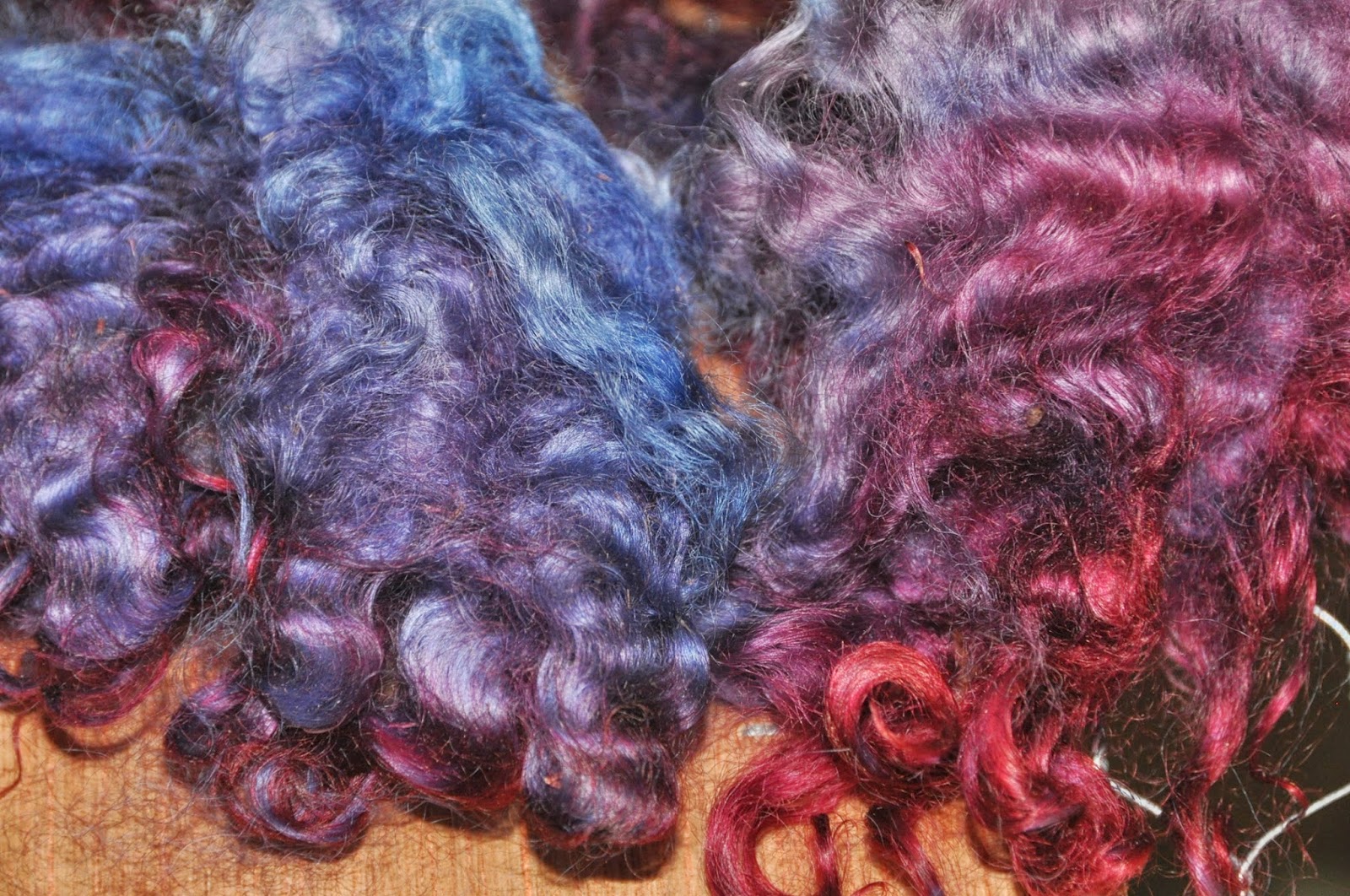
Look at this - the dye broke!  Even though the powders were totally dissolved in the water, the blue jumped onto some locks and the butt part of others and the red component went largely to the tips of the locks.


That ought to make some really pretty purple roving when it's carded together!

Holly says:

"I think I've had as much fun out here as I can stand.  Can we go to the house?"

Yep, time to let the wool dry and we'll go do something else.

Saturday, February 14, 2015

Yes, We're Tired of Winter


Calling for -7 F tonight, high of -3 tomorrow and -12 tomorrow night.  Windchills expected to be around -30 F.
Eeesh.